


Multi Family Real Estate Investing: The 2026 Blueprint for Scaling Wealth
Updated: Mar 13
The dream of scaling through single-family rentals is a mathematical trap that keeps 92% of investors trading their time for tiny checks. You've likely felt the exhaustion of managing a scattered portfolio that feels more like a second job than a path to freedom. It's time to stop thinking small. Mastering multi family real estate investing is the only way to decouple your income from your hours and achieve true Passive Wealth. You've worked hard to build your current portfolio, but you've hit a ceiling that requires a new blueprint to break through.
This guide gives you the exact strategies to dominate the 2026 market, even when interest rates hover above 6.5%. We'll show you how to analyze apartment deals with 100% confidence so you never overpay for an underperforming asset again. You'll learn to unlock off-market deal flow by leveraging The Network, giving you access to the 80% of high-value transactions that never hit the public market. From syndication secrets to advanced asset management, we're providing the roadmap to scale your net worth and reclaim your life. Let's accelerate your journey to professional mastery.
Key Takeaways
Stop trading time for doors and discover why a single 100-unit acquisition accelerates your path to Passive Wealth faster than a century of single-family rentals.
Unlock massive equity by mastering the commercial valuation blueprint, shifting your focus from market comps to the power of Net Operating Income (NOI).
Navigate the "Capital Stack" with precision to fund your deals using sophisticated debt and equity strategies that move beyond traditional bank limitations.
Gain an exclusive edge in multi family real estate investing by sourcing off-market opportunities that never hit the public eye.
Transform your growth into a team sport by leveraging The Network to scale your empire and bypass the million-dollar mistakes of solo investing.
Table of Contents Why Multi Family Real Estate Investing is the Ultimate Wealth Accelerator The Multifamily Mindset: How Commercial Valuation Works Strategic Deal Analysis: Cracking the Code on NOI and Debt Sourcing and Funding: Moving Beyond Traditional Bank Loans Scaling Your Empire: Why You Need a Multifamily Network
Why Multi Family Real Estate Investing is the Ultimate Wealth Accelerator
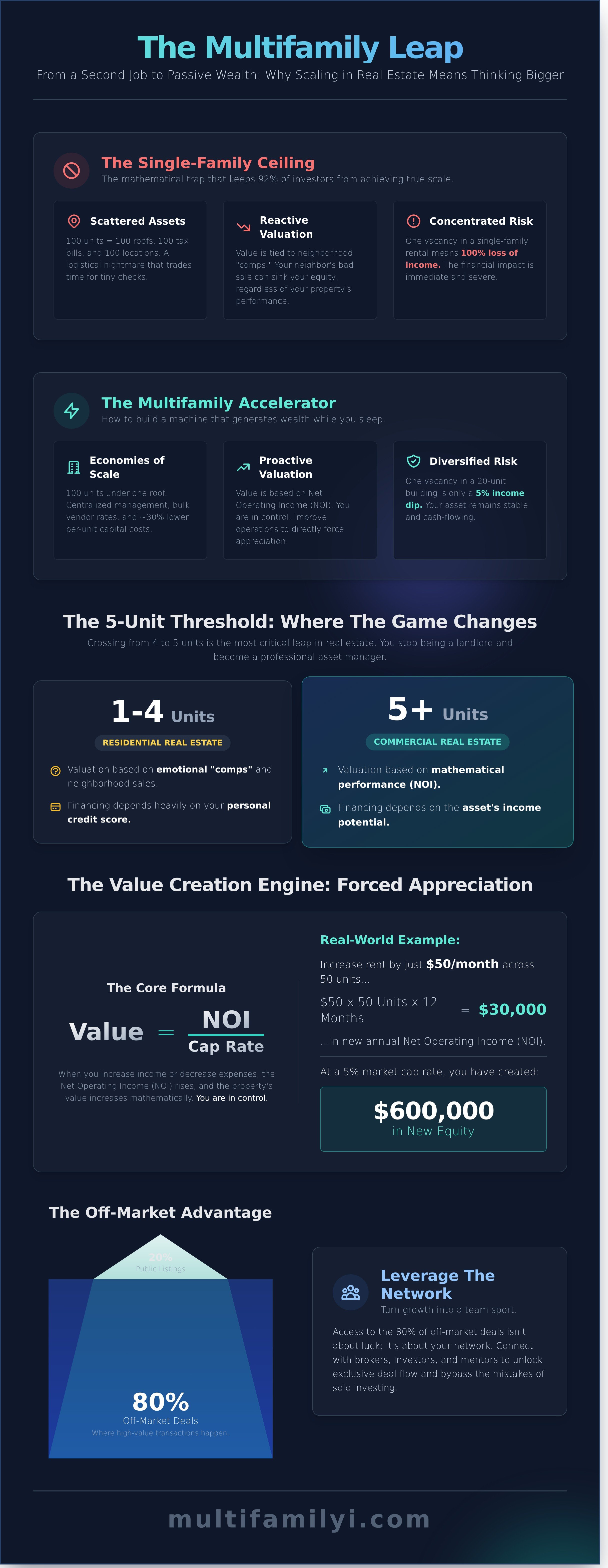
Stop trading time for doors. True Real estate investing at scale begins when you cross the threshold into assets with 5 or more units. This is the precise point where you stop being a landlord and start being a professional asset manager. By January 2026, the demand for high-density housing will outpace single-family supply by an estimated 22 percent. Investors who master multi family real estate investing now will dominate the next decade. It's about building a machine that works while you sleep.
Imagine managing 100 units. You can do it with one high-performing property manager and a single physical location. Try doing that with 100 single-family homes scattered across the city. You'd face 100 different roofs, 100 separate tax bills, and 100 different landscaping schedules. That's a job; it's not a business. Multifamily is about the exit strategy and the lifestyle it buys you. You want to unlock freedom, not create a second career as a glorified repairman. The goal is to consolidate your efforts and maximize your output.
The 2026 market context proves that apartments remain the most resilient asset class in any economic cycle. While office spaces face a 15 percent vacancy rate and retail continues to fluctuate, people always need a place to sleep. This stability is why institutional capital is flooding the multifamily space. You need to be where the smart money is. Scaling Up isn't just a goal; it's a necessity for anyone looking to protect their capital against inflation. The Network you build today determines the deal flow you see tomorrow. Don't just watch the market; dominate it.
The Power of Economies of Scale
Centralization is your competitive edge. When you replace one roof on a 20-unit building, your cost per unit drops by roughly 30 percent compared to a single-family replacement. You negotiate better rates with vendors because you offer volume. Your trash pickup, landscaping, and maintenance are all consolidated into a single contract. Passive Wealth is the point where your asset income exceeds your lifestyle costs. Achieving this requires the efficiency of scale that only large assets provide. By 2026, operational efficiency will be the primary driver of alpha in your portfolio.
Residential vs. Commercial Multifamily: The 5-Unit Threshold
The game changes at unit five. Properties with 1 to 4 units are residential; they rely on emotional comps and neighborhood sales. Once you hit 5 units, you enter the commercial realm. Financing shifts from personal credit scores to the income-producing potential of the asset. Banks value these assets based on Net Operating Income (NOI). This shift allows you to force value. Increase the rent by $50 across 50 units, and you've added $30,000 to your annual income. At a 5 percent cap rate, you just created $600,000 in equity. You don't wait for the market to go up; you drive it up through professional management.
5+ Units: Classified as commercial real estate with specialized lending.
NOI Focus: Value is driven by income, not just neighborhood sales.
Forced Appreciation: Control your equity through operational improvements.
Risk Mitigation: One vacancy in a 20-unit building is 5 percent; one vacancy in a house is 100 percent.
The Multifamily Mindset: How Commercial Valuation Works
Residential real estate depends on "comparable sales." If your neighbor sells their house at a discount, your property value takes a hit regardless of your home's condition. This is a reactive way to build wealth. In contrast, multi family real estate investing operates on an income-based valuation model. This shift moves you from a passive observer to a wealth architect. Commercial assets are valued based on the math of their performance, not the whims of the house next door. This puts the investor in the absolute driver’s seat of wealth creation.
The core formula for success is simple: Value = Net Operating Income (NOI) / Cap Rate. This equation is your roadmap to professional mastery. When you increase the income or decrease the operating expenses, the property value rises mathematically. You don't have to wait for the market to "go up" to make money. You create the value through strategic asset management. By securing financing through HUD Multifamily Loan Programs, you gain access to stable, long-term leverage that empowers you to execute this formula at scale.
Investors often ask about the risks of a market dip. While single-family homes can see equity evaporate overnight, multifamily assets rely on cash flow safety. People always need a roof over their heads. Even during economic contractions, a well-managed building continues to produce monthly checks. This consistent cash flow acts as a fortress, protecting your capital while you wait for the next growth cycle. You aren't playing for a quick flip; you're building a legacy of passive wealth that survives any market cycle.
Forced Appreciation: The Secret Weapon
Market appreciation is luck. Forced appreciation is skill. If you raise the rent by just $100 across a 50-unit building, you generate an extra $60,000 in annual NOI. At a 6% capitalization rate, that simple move adds exactly $1,000,000 to your building's sale price. You can also unlock value by slashing utility costs or renegotiating trash contracts. Every dollar you save in expenses is an instant boost to your net worth. This is how high-performers accelerate their journey to total lifestyle freedom.
Beyond operational tweaks, physical upgrades play a major role in forced appreciation. Improving a property's security and curb appeal through professional door replacement and repair, for instance, can directly impact tenant retention and justify higher rents. Asset managers looking for a model of this type of specialized service can discover Liberty Door Repair, a company that provides these value-add improvements in the Atlanta market.
One of the most effective ways to reduce operating expenses is by ensuring your building's HVAC systems are efficient and reliable. Upgrading or properly maintaining these systems can lead to significant savings on utility bills, directly impacting your NOI. For those looking into professional services for their properties, you can discover RMI Heating and Air Conditioning.
Understanding Cap Rates in 2026
The Capitalization Rate represents your unleveraged return on investment. In 2026, cap rates have shifted to reflect the current interest rate environment. When interest rates rise, cap rates typically follow, which often lowers entry prices for savvy buyers. This creates a massive opportunity for those ready to dominate the market. To simplify these variables and ensure your deal flow remains profitable, use the Multifamily Analyzer to stress-test your assumptions. Mastering these numbers is the only way to ensure you're buying assets that will scale your portfolio effectively.
If you're ready to stop guessing and start growing, it's time to evaluate your next deal with precision and confidence.
Strategic Deal Analysis: Cracking the Code on NOI and Debt
Underwriting isn't just a spreadsheet exercise; it's the heartbeat of your entire investment strategy. A "good" deal offers a 15% internal rate of return or better, backed by conservative growth assumptions and a clear exit plan. Conversely, a "trap" deal lures you in with a high cap rate that evaporates once you account for the 2024 insurance premium hikes, which have climbed by 28% in coastal California markets. You must master the capital stack to win. This stack layers your funding: senior debt takes the first position, followed by mezzanine financing or preferred equity, with common equity at the base. High-performance multi family real estate investing requires you to balance these layers to maximize your cash-on-cash return without over-leveraging the asset.
Newbie investors often fall into the "pro forma" trap. They trust the seller's marketing package instead of reality. The most lethal mistake is ignoring the property tax reset. In California, Proposition 13 limits increases for current owners, but the moment you close, the county reassesses the property at your purchase price. If you don't model your taxes at roughly 1.2% of the new acquisition cost, your cash flow will vanish on day one. Precise underwriting is the only way to protect your capital and ensure your multi family real estate investing journey leads to freedom rather than a financial bottleneck.
Mastering the NOI (Net Operating Income)
Your NOI is the engine of your asset's value. To dominate the market, stop looking only at the rent roll. Smart operators unlock hidden revenue through ancillary streams. These include:
Monthly pet rent: typically $50 to $75 per unit.
Reserved parking fees: $100 to $200 in high-demand La Jolla pockets.
On-site laundry or in-unit machine rentals.
Secure storage lockers for bikes and surfboards.
Control the "Big Three" expenses: property taxes, insurance, and utilities. Never trust a "stabilized" budget from a broker. Demand the Trailing 12 Months (T12) data. The T12 provides an unvarnished look at the actual money moving through the property over the last 365 days. It exposes the truth about maintenance leaks and vacancy spikes that a single-month snapshot hides.
In high-stakes deals where the valuation hinges on digital financial records, verifying their integrity is paramount. Sophisticated investors may even consult with a firm like the International Investigative Group to conduct forensic analysis on digital documents, ensuring the numbers are legitimate and haven't been manipulated.
Leveraging Debt to Dominate the Market
Debt is your greatest tool for wealth acceleration. You generally choose between recourse and non-recourse loans. Recourse debt puts your personal assets on the line if the deal fails; non-recourse debt limits the lender's recovery to the property itself. For long-term stability, Agency debt from Fannie Mae or Freddie Mac is the gold standard. These programs offer competitive 30-year amortizations and non-recourse terms that protect your personal balance sheet. Your Debt Service Coverage Ratio (DSCR) determines your loan amount by ensuring the property's net income can comfortably cover the annual mortgage payments with a typical 1.25x safety margin.
Sourcing and Funding: Moving Beyond Traditional Bank Loans
Stop letting the 25% down payment myth kill your dreams. Most aspiring investors stall because they think they need $500,000 in liquid cash to touch a $2 million asset. That's old-school thinking. In 2024, the most aggressive players in multi family real estate investing are using other people's money to scale. You don't need to be wealthy to start; you need to be resourceful. High-performing investors focus on deal flow and creative structures rather than their own bank balances.
The best deals never see a "For Sale" sign. By the time a property hits the MLS, the margins have been squeezed by a dozen bidding wars. You want the "tired landlord" who has owned a property since 1995 and is exhausted by California's complex regulations. These owners often prefer a quick, quiet exit over a public spectacle. Finding them is the difference between a 4% cap rate and a double-digit return.
The Art of the Off-Market Hunt
Finding these opportunities requires a proactive strike. You must target specific zip codes like 92037 and use direct mail or cold calling to reach owners directly. Data from 2023 shows that off-market acquisitions can save investors 10% to 15% on the purchase price because you're eliminating broker fees and public competition. Build your "Network" now. Real estate is a contact sport; the more hands you shake, the more doors you open. You can learn these exact sourcing tactics by joining the 5-Day Multifamily Challenge to bridge the gap between searching and closing.
Direct Mail: Send personalized letters to owners with high equity.
Cold Calling: Reach out to owners of properties with visible deferred maintenance.
The Network: Connect with local property managers who know which owners are ready to quit.
Creative Financing and Syndication
As we look toward the 2026 interest rate environment, traditional debt will remain a hurdle for those without a strategy. This is where the "Seller Carryback" becomes your most powerful tool. In this scenario, the seller acts as the bank. They hold a portion of the equity as a loan, which drastically reduces your cash-to-close requirements. It's a win-win. The seller gets a steady interest-bearing income stream without the management headaches, and you get the keys with minimal capital out of pocket.
For larger assets, stop trying to buy alone. Syndication allows you to pool capital from passive investors to dominate the market. You take the role of the General Partner (GP), managing the asset and executing the strategy. Your investors act as Limited Partners (LPs), providing the capital in exchange for a share of the cash flow. You aren't just buying a building; you're selling a vision of Passive Wealth. This structure is the primary engine for multi family real estate investing, allowing savvy groups to acquire over $10 billion in assets nationally in the last 24 months. You provide the expertise, they provide the fuel, and everyone shares in the victory.
Ready to master the art of the deal? Secure your spot in our next training session and learn how to fund your future without traditional banks.
Scaling Your Empire: Why You Need a Multifamily Network
Single-family investing is a trap that keeps you small. It forces you to act as a solo operator, often playing the roles of plumber, accountant, and leasing agent simultaneously. This approach is a grind that trades your most valuable asset, time, for a slow trickle of dollars. To achieve true financial dominance, you must shift your mindset. Multi family real estate investing is not a solo pursuit; it is a high-stakes team sport. When you scale to 50, 100, or 200 units, the operational complexity demands a sophisticated infrastructure. You aren't just buying a building; you are acquiring a business that requires professional asset management, specialized legal counsel, and strategic partnerships.
Stop trading hours for equity. If you spend 30 hours a month managing five single-family rentals, you've simply bought yourself a second job. Scaling into the multifamily sector allows you to build a massive asset base that generates passive wealth while professional teams handle the daily friction. This transition is how you unlock lifestyle freedom. The Network is the bridge that carries you from being a weary landlord to becoming a powerful asset manager. You need a community that understands the nuances of syndication and capital stacks to accelerate your growth. Consider these core benefits of a dedicated network:
The journey to becoming a powerful asset manager can be psychologically demanding, and maintaining mental clarity is key to making sound decisions under pressure. For women navigating this high-stakes environment, specialized support can be invaluable. To explore resources tailored to these unique challenges, you can learn more about Female Focused Therapy.
Access to Deal Flow: Approximately 75% of the best multifamily deals never hit the open market. They are traded between trusted peers.
Capital Partnerships: Find the equity partners you need to close on $10 million plus assets that would be impossible to take down alone.
Operational Benchmarking: Compare your expense ratios and occupancy rates with top performers to find hidden profit in your portfolio.
This mindset of continuous operational improvement is crucial. While not specific to real estate, many scaled businesses adopt formal quality management systems to ensure consistency and efficiency. To see how this is achieved in other sectors, visit Align Quality and learn about standards like ISO 9001.
The ROI of Mentorship and Coaching
A single "course correction" on a deal can pay for a lifetime of coaching. If you miscalculate an exit cap rate by just 0.5% on a $15 million asset, you could be looking at a $1.5 million swing in valuation. Having a seasoned Multifamily Attorney like Charles Dobens in your corner provides the technical guardrails needed to avoid these catastrophic errors. Mentorship isn't an expense; it's the ultimate shortcut to professional mastery. It's the difference between guessing on a purchase and sale agreement and executing a contract that protects your earnest money. Beyond the technical skills, the community aspect is where you find your future general partners. In this environment, proximity is power. Surrounding yourself with investors who are already closing 100-unit deals forces your own expectations to rise. You stop asking "if" you can do it and start asking "how fast" you can scale.
The best legal partners for this kind of high-stakes investing are often those who have streamlined their own operations. If you're curious about the kind of client acquisition systems that allow top real estate law firms to scale effectively, you can discover Retainer Engine.
Your Next Steps to Passive Wealth
Information without execution is a recipe for stagnation. You've analyzed the laws and understood the market dynamics of La Jolla; now you must pull the trigger. The gap between your current financial state and your ultimate goals is filled with action. Don't let another year pass while you watch others build empires. Join the Personal Mentorship Program to gain the tools, the network, and the confidence to dominate the multi family real estate investing space. Data from our community shows that investors with a formal mentor scale their portfolios 3x faster than those attempting the "DIY" route. The best time to buy was 10 years ago; the second best time is today. Secure your seat at the table and start building the asset base that secures your legacy. Execute now.
Claim Your Seat at the 2026 Deal Table
The 2026 landscape demands a shift from amateur tactics to professional mastery. You've learned how commercial valuation hinges on Net Operating Income (NOI) to force appreciation. You understand that sourcing deals requires moving beyond traditional banks into creative syndication. These aren't just theories; they're the core mechanics of multi family real estate investing that separate the hobbyists from the titans. Success in this high-stakes game isn't about working harder; it's about leveraging the right tools and proximity to power.
Charles Dobens, The Multifamily Attorney, has spent over 10 years refining this exact blueprint for thousands of successful students. Our proprietary deal analysis software removes the guesswork from your projections, ensuring every acquisition aligns with your scaling goals. Stop waiting for the perfect market and start building your empire today. You need a network that provides the deal flow and capital necessary to dominate this asset class. Join Multifamily Intelligence and Scale Your Portfolio to access a decade of specialized commercial real estate training. Your path to total lifestyle freedom is waiting. Let's secure your legacy.
Frequently Asked Questions
Is multi family real estate investing still profitable in 2026?
Yes, multi family real estate investing remains a premier vehicle for wealth because housing demand outstrips supply by 4.3 million units as of early 2026. Rent growth in coastal markets like La Jolla is projected at 4.2% this year. You aren't just buying a building; you're securing an inflation-hedged asset. Scale your portfolio now to capture the 12% average annual returns seen in high-demand California submarkets. This is how you unlock true financial independence.
How much money do I need to start investing in multifamily properties?
You typically need a 20% to 25% down payment for a conventional loan on a 5-unit building, which often equates to $250,000 in competitive coastal markets. FHA loans allow for 3.5% down on properties with up to 4 units if you live in one. If you're targeting larger commercial assets, expect to bring $500,000 or more to the closing table. Join an elite network to pool capital and unlock larger deals with less personal exposure.
What is the difference between a residential and a commercial multifamily property?
The primary difference is the unit count, where properties with 1 to 4 units are residential and those with 5 or more units are commercial. Commercial assets use Net Operating Income to determine value rather than just local comps. This allows you to force appreciation by 15% or more through strategic renovations. Commercial lending also focuses more on the property's cash flow than your personal debt-to-income ratio.
Can I invest in multifamily real estate with no money down?
You can scale your multi family real estate investing with zero cash out of pocket by using seller financing or bringing in a private equity partner to cover the 25% down payment. Master lease options let you control a property's cash flow without a bank loan. In 2025, 18% of creative deals utilized these structures to bypass high interest rates. Use these strategies to dominate the market while keeping your liquidity for the next big play.
What is a good cap rate for a multifamily investment?
A strong cap rate in a stabilized market like San Diego currently ranges between 4.5% and 5.5% for Class A assets. Higher-risk markets might offer 7% or 8%, but you sacrifice long-term appreciation. Focus on the spread between your cap rate and interest rate to ensure positive leverage. Aim for a 2% spread to accelerate your path to total financial freedom and passive wealth.
How do I find off-market multifamily deals?
Secure off-market deals by direct mailing owners of buildings with 10 or more units or by leveraging a high-level investor network. Roughly 35% of the best deals never hit the MLS. Use skip tracing tools to find owners with 20% or more equity. Building direct relationships with brokers allows you to see pocket listings before they go public. This is how you win in a crowded market.
What is a real estate investment syndicate?
A real estate investment syndicate is a partnership where multiple investors pool their capital to purchase a large asset they couldn't afford alone. The sponsor manages the deal flow and operations while passive investors receive a share of the quarterly distributions. Many syndications target a 15% internal rate of return over a 5-year hold period. It's the fastest way to scale your portfolio without the headaches of daily management.
Do I need a property manager for my multifamily building?
You need a professional property manager once your portfolio exceeds 10 units to ensure you remain focused on asset management and deal flow. Professional firms typically charge 4% to 8% of gross monthly income. They handle the 2:00 AM maintenance calls and legal compliance. Outsourcing these tasks buys back your time, which is your most valuable asset. Don't let tenant disputes slow your momentum toward professional mastery.
This level of professionalism extends to ensuring your on-site teams are prepared for any situation. Equipping staff with first aid and CPR training is a key part of risk management and tenant care. While they operate in Canada, organizations like Aspire First Aid Guide Training Corp offer the kind of certifications that prudent asset managers incorporate into their operational planning.
These maintenance calls often involve critical household appliances, and having a reliable service partner is key. While this article focuses on the US market, the principle is universal; for instance, investors in London looking for a comprehensive appliance management partner can discover FaultFree Engineering Group.


Comments