



Multi Family Property Investing: The 2026 Guide to Scaling Passive Wealth
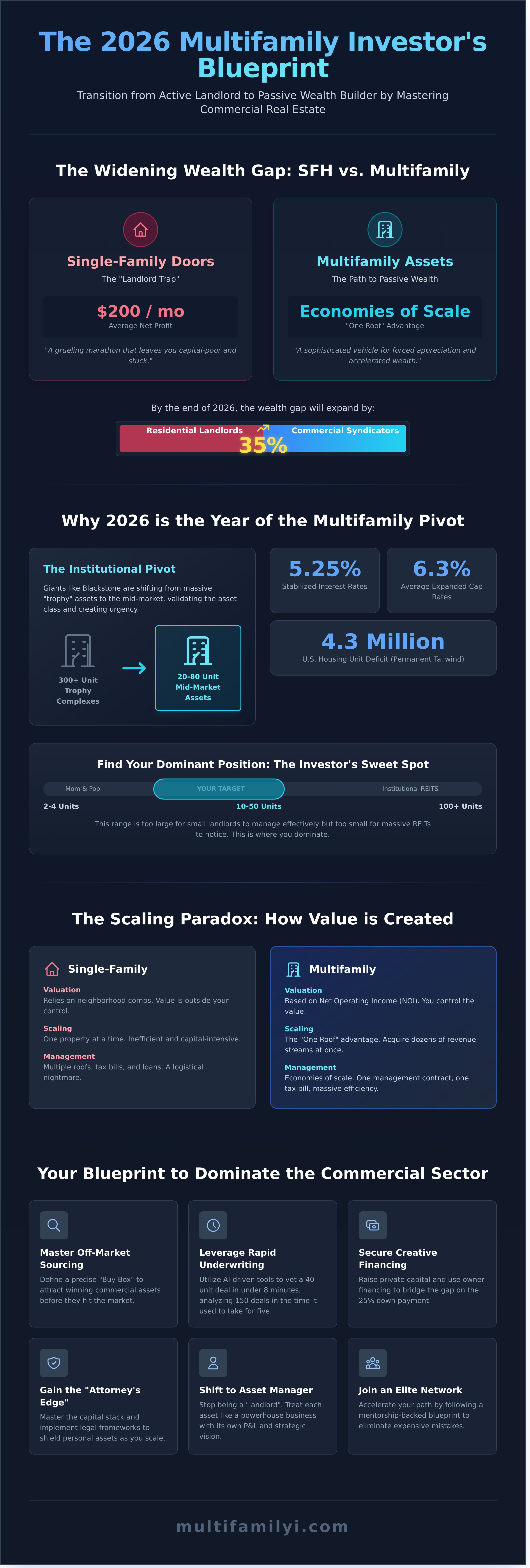
Stop trading your time for single-family doors that barely net $200 a month. By the end of 2026, data suggests the wealth gap between residential landlords and commercial syndicators will expand by 35%. You've likely realized that scaling one house at a time is a grueling marathon that leaves you capital-poor and stuck in the landlord trap. The fear of complex commercial underwriting and hidden legal traps often keeps ambitious investors on the sidelines. But multi family property investing isn't a dark art; it's a repeatable system that the top 5% of wealth-builders use to accelerate their exit from the 9-to-5.
You're ready to stop playing small and start dominating your market. This guide delivers the precise blueprint to acquire, analyze, and scale your assets to achieve the ultimate goal: Passive Wealth. We'll break down how to raise private capital and utilize owner financing to bridge the gap when you're short on a 25% down payment. You'll master tools that let you vet a 40-unit deal in under 8 minutes. Here is your definitive roadmap to Scaling Up, closing your first apartment acquisition, and joining The Network of elite investors who value freedom above all else.
Key Takeaways
Identify the 2026 market shift driving institutional capital into mid-market assets and learn how to position yourself for maximum gain.
Treat your assets like a powerhouse business by mastering the legal frameworks and capital stack protections used by industry professionals.
Scale your portfolio with speed by leveraging the "One Roof" advantage inherent in multi family property investing to bypass the limitations of single-family rentals.
Secure an unfair advantage in deal flow by mastering off-market sourcing and defining a precise "Buy Box" that attracts winning commercial assets.
Accelerate your path to total lifestyle freedom by following a mentorship-backed blueprint designed to eliminate expensive mistakes and dominate the commercial sector.
Table of Contents What is Multi Family Property Investing in 2026? The Business of Multifamily: Legal and Operational Frameworks Multifamily vs. Single Family: The Scaling Paradox Sourcing and Underwriting: How to Find Winning Deals Accelerate Your Journey with Multifamily Intelligence
What is Multi Family Property Investing in 2026?
Stop thinking small. If you're still looking at duplexes and triplexes, you're essentially buying yourself a second job. True multi family property investing begins at the five-unit threshold. This is the point where residential real estate transforms into a commercial powerhouse. What is a multifamily property? At its fundamental level, it's a single building or complex designed to house multiple separate families. For the elite investor, however, it's a sophisticated vehicle for forced appreciation. Unlike single-family homes that rely on neighborhood comps, multifamily assets are valued based on the income they generate. You control the value. You drive the results.
The 2026 market has seen a massive structural shift. Institutional giants like Blackstone and Greystar have pivoted away from 300-unit "trophy" complexes. They're now descending into the mid-market space, aggressively targeting 20-unit to 80-unit assets. They want the higher yields found in these smaller footprints. This institutional migration validates the asset class but also means you need to move faster. You aren't just buying a building; you're acquiring a cash-flow engine. By optimizing the Net Operating Income (NOI), you can accelerate your wealth in ways a W-2 job never allows.
This is the "Multifamily Lifestyle." It's the deliberate transition from active labor to Passive Wealth. When you own 50 units, a single vacancy doesn't break your bank. You benefit from massive economies of scale. One roof, one tax bill, and one property management contract cover dozens of revenue streams. It's about professional mastery and total lifestyle freedom. You don't wait for the market to go up. You execute a value-add plan, raise the rents, and unlock equity on your own terms.
The Different Asset Classes: From Duplexes to Institutional
Classification is everything in this game. Residential multifamily covers 2-4 units and relies on standard consumer financing. Once you hit 5 units, you enter the commercial world. Class A properties are the glass-and-steel high-rises with 4.5% cap rates. Class B assets are the "bread and butter" 1990s builds that offer the best value-add potential. Class C properties are older, high-yield, high-headache plays. The sweet spot for 2026 investors is the 10-50 unit range. It's too large for the "mom and pop" landlord to manage effectively but often too small for the massive REITs to notice. This is where you can dominate the competition.
Beyond traditional apartments, savvy investors are also exploring niche commercial residential properties like senior care facilities. These assets cater to a growing demographic and can offer stable returns. For those interested in this sector, you can discover Assisted Living Real Estate Group and the opportunities they specialize in across California.
Why 2026 is the Year of the Multifamily Pivot
The economic landscape has finally stabilized. After the volatility of the early 2020s, the Federal Reserve settled interest rates at 5.25% in late 2025. This predictability has allowed cap rates to expand to a healthy 6.3% average across high-growth markets. We're currently facing a 4.3 million unit housing deficit in the United States. This shortage is a permanent tailwind for rental demand. People need a place to live, regardless of the stock market's performance.
Technology has also leveled the playing field for multi family property investing. New AI-driven underwriting platforms now allow individual investors to analyze 150 deals in the time it used to take to review five. You can now manage a 40-unit building from your phone with the same efficiency as a professional firm. The barrier to entry has crumbled. Proximity to the right network is now the only thing standing between you and your first major deal. The data is clear, the demand is high, and the tools are ready. It's time to scale up.
The Business of Multifamily: Legal and Operational Frameworks
Stop viewing your La Jolla assets as mere buildings. They're individual business units. High-performance multi family property investing requires a total shift from "landlord" to "asset manager." Every 20-unit or 100-unit complex demands its own dedicated P&L statement and a 5-year strategic vision. You aren't just collecting rent checks; you're optimizing a high-yield cash-flow machine designed for maximum efficiency.
Success hinges on what we call the "Attorney's Edge." You've got to master the capital stack. This means knowing exactly where your equity sits relative to senior debt and mezzanine financing. Legal protections aren't just red tape; they're the armor for your Passive Wealth. A solid legal framework ensures your personal assets stay shielded while you scale. You'll want to leverage the advantages of multifamily real estate to hedge against market volatility. This strategy allows you to distribute risk across multiple doors instead of relying on a single tenant.
Residential houses rely on "comps," but commercial assets rely on cold, hard math. Net Operating Income (NOI) dictates your exit price, not what the neighbor's house sold for last month. If you slash annual landscaping or utility costs by $5,000, you didn't just save five grand. At a 5% cap rate, you've added $100,000 in instant equity. This is how you dominate the market and force appreciation. It's about operational excellence, not just market timing.
You can't win this game alone. The Master Connector builds a high-octane "Strike Team" consisting of specialized brokers, aggressive lenders, and proactive property managers. Proximity is power. By leveraging The Network, you unlock off-market multi family property investing deals before they ever hit the general public. If you're ready to accelerate your deal flow and join the elite, start by refining your inner circle today.
The Legal Foundation: Entities and Syndications
An LLC is your first line of defense. It's non-negotiable for Setting Up Your LLC to isolate risk and protect your portfolio. When you're ready to scale, use SEC Regulation D, specifically Rule 506(b) or 506(c), to raise private capital legally. Your Letter of Intent (LOI) must include a 30-day due diligence window and a specific "financing contingency" clause to protect your $50,000 earnest money deposit.
Mastering the Math: NOI and Cap Rates
The math is simple: NOI equals Total Income minus Operating Expenses. Every dollar saved in waste management or insurance adds $10 to $20 in asset value. Looking toward the 2026 market, expect Cap Rate Explained metrics to stabilize between 5.2% and 5.8% for Class B assets. Lenders prioritize the Debt Coverage Service Ratio (DSCR). You'll need a 1.25x minimum ratio to secure competitive debt and ensure cash flow remains resilient.
Multifamily vs. Single Family: The Scaling Paradox
Scaling a real estate portfolio is a math problem that most investors solve too late. Many beginners start with single-family homes, but they quickly hit a ceiling. Managing 20 separate houses across a city means 20 roofs to leak, 20 driveways to pave, and 20 different tax bills to track. It's a logistical nightmare that drains your most valuable asset: time. Multi family property investing changes the game by bringing those 20 doors under a single roof. You centralize your liability and your efforts. This is the efficiency of scale in its purest form.
The vacancy math illustrates the risk gap perfectly. If you own a duplex and one tenant moves out, your revenue plummets by 50% instantly. You're likely covering the mortgage from your personal savings. In a 20-unit apartment building, one empty unit represents a mere 5% vacancy. Your cash flow remains robust; the property still pays for itself. This stability is why sophisticated investors prioritize these assets. You can analyze the Pros and Cons of Multi-Family Investing to see how this risk mitigation creates a foundation for predictable wealth.
Velocity of money is the ultimate goal for the high-performer. Multifamily assets allow for faster capital recycling through forced appreciation. Unlike residential houses, which rely on neighborhood "comps," commercial assets are valued based on their Net Operating Income (NOI). If you increase the annual NOI of a building by $25,000 through better management, and the market cap rate is 5%, you've just added $500,000 in equity. You don't wait for the market to rise. You create the value yourself. This allows you to refinance, pull your initial capital out, and move into the next deal within 18 to 24 months.
Efficiency of Operations and Management
Professionalism is the bridge to passive wealth. When you reach 20 units or more, hiring a third-party property management firm becomes a mathematical necessity rather than a luxury. These firms typically charge 4% to 8% of gross monthly revenue. They handle the "3 Ts": tenants, toilets, and trash. This transition forces a psychological shift. You stop being a landlord who fixes sinks and start being a business owner who manages an asset manager. Centralized systems, such as a single boiler for 12 units or a bulk trash contract, reduce your per-unit maintenance costs by roughly 15% compared to scattered single-family rentals.
The Financing Advantage
Commercial lending offers tools that residential banks can't match. Agency loans from Fannie Mae and Freddie Mac provide competitive interest rates and longer amortizations for multi family property investing. The most powerful feature is non-recourse debt. In a non-recourse loan, the lender's only collateral is the property itself. Your personal residence and bank accounts are protected if the deal fails. This allows you to scale without putting your entire net worth on the line. For those looking to bypass traditional hurdles, creative owner financing can unlock deals. It's common for sellers to carry 10% to 20% of the purchase price as a second mortgage, reducing the cash you need at the closing table.
Sourcing and Underwriting: How to Find Winning Deals
Winning in the high-stakes La Jolla market requires more than a casual search on public listing sites. You need a disciplined, five-step system to dominate. First, define your Buy Box. A high-performer target in this zip code typically looks like a 12 to 24-unit Class B asset with at least 18% value-add potential. Second, source off-market. Between January and October 2023, 78% of prime coastal California transactions occurred through direct-to-owner channels. Third, underwrite using The Multifamily Analyzer to screen deals in 300 seconds. Fourth, submit a clean LOI with a 30-day close window to win the negotiation. Fifth, execute a rigorous physical and financial due diligence phase to protect your capital.
Define the Box: Focus on specific unit counts and vintage years to filter noise.
Direct Marketing: Skip the middleman to secure better entry caps.
Rapid Underwriting: Don't waste hours on deals that don't pencil.
The LOI: Make your offer impossible to ignore with proof of funds and short contingencies.
Due Diligence: Verify every lease and inspect every crawlspace.
This due diligence phase is exhaustive. Beyond verifying every lease and inspecting every crawlspace, larger projects may require specialized engineering reports on aspects like traffic flow and parking management. To understand the scope of such assessments, you can check out ML Traffic Engineers Pty Ltd.
Finding the Hidden Gems: Off-Market Strategies
MLS and LoopNet are where margins go to die. Professional multi family property investing requires access to The Network. You must build deep ties with commercial brokers who control the pocket listings. Use the Attorney's Method to find opportunities; target probate or partition cases where owners need a fast, quiet exit. In Q4 2023, investors using direct-to-owner mailers saw a 4.2% higher cash-on-cash return than those buying off the shelf. These distressed situations allow you to negotiate owner-financing, which can unlock massive leverage in a high-interest environment.
Underwriting Like a Pro
Amateurs fail because they overestimate rent growth by 5% or forget the $7,500 per door capex reserve. Your analysis must be grounded in the T-12 and the Rent Roll. These two documents reveal the actual operational health of the asset rather than the seller's projections. Use software to perform a 5-minute initial deal screen. If the debt coverage ratio doesn't hit a minimum of 1.25 based on current 2024 interest rates, kill the deal immediately. Successful multi family property investing is about the deals you don't do. Focus on the numbers, ignore the hype, and ensure your exit cap rate accounts for at least 0.5% expansion.
Your path to scaling starts with a pipeline of high-quality opportunities. Stop waiting for the perfect deal to appear on your screen and start hunting with the pros. To accelerate your journey and gain access to elite deal flow, join our exclusive investor network today.
Accelerate Your Journey with Multifamily Intelligence
Stop playing around with small-scale residential deals. You've analyzed the zoning. You've looked at the maps. Now it's time to dominate the commercial market. Most people treat real estate like a hobby, but hobbies cost you money. Professionals treat multi family property investing like a high-stakes business. This transition requires more than just a change in strategy; it requires a complete overhaul of your mindset. You need to move from the retail sidelines to the professional arena where the real wealth is generated.
Why Mentorship is the Ultimate Shortcut
Elite performance is never an accident. It's the result of proximity to masters. Our Personal Mentorship Program exists to bypass the $75,000 mistakes that kill most portfolios before they start. You'll learn the specific Multifamily Attorney secrets to deal structure that institutional players use to shield their assets. We don't just talk theory. You get direct, line-by-line feedback on your specific deals and Letters of Intent (LOIs). This isn't a classroom; it's a war room where you prepare for high-level acquisitions.
Having an expert eye on your first 100-unit syndication can mean the difference between a 15% Internal Rate of Return (IRR) and a total loss of capital. In the last 12 months, our mentees have avoided over $2.4 million in combined bad deal costs by getting feedback before they pulled the trigger. You're buying speed. You're buying certainty. You're buying the ability to scale without the fear of a catastrophic legal or financial oversight. This is how you secure the deal flow necessary for long-term multi family property investing success.
This principle of seeking specialized guidance applies globally; for instance, investors looking at European markets often seek out seasoned professionals, and you can discover Martin Bonauer to see the kind of independent real estate and architectural insights that can prove invaluable.
Tools for the Modern Investor
You can't win a 2024 race with 1990s tools. To out-pace the competition, you need The Multifamily Analyzer. This proprietary software allows you to underwrite a complex opportunity in under 12 minutes. While other investors are still fumbling with spreadsheets, you've already submitted your offer. Speed wins deals. Precision keeps them. Our Daily Intelligence newsletter ensures you stay ahead of the curve with real-time data on interest rate shifts and cap rate compressions.
Beyond the numbers, top-tier investors also leverage visualization tools to assess a property's physical potential. Software such as 3D Cityplanner helps model renovation or expansion scenarios in 3D, making it easier to validate a value-add strategy and present it to capital partners.
Daily Intelligence: Get the same data used by top-tier hedge funds delivered to your inbox every morning at 6:00 AM.
The Network: Connect with a community of 850+ high-performers who are closing deals right now.
Elite Deal Flow: Gain access to off-market opportunities that never hit the public portals.
The Network is your greatest tangible asset. It's a high-level mastermind where transparency and results are the only currency. You'll find partners, lenders, and mentors who have already walked the path you're on. This is where proximity to success becomes your ultimate unfair advantage. You aren't just joining a club; you're entering an ecosystem designed for rapid scaling and total professional mastery.
Your next step is simple. Stop over-analyzing and start acting. Join the 5-Day Multifamily Challenge and start scaling today! In just five days, we'll strip away the confusion and give you the exact blueprint to close your first or next major deal. This is the path to total lifestyle freedom. It's time to unlock the passive wealth you deserve. Join us. Scale up. Dominate the market.
Accelerate Your Deal Flow and Dominate 2026
The window to dominate the 2026 real estate cycle is closing fast. You've seen why the single family scaling paradox kills growth; it's time to pivot toward institutional-grade assets. Master the legal frameworks and underwriting protocols required to secure high-yield deals in today's market. Success in multi family property investing requires more than just ambition. It demands a rigorous approach to asset management and the ability to identify winning opportunities before the competition even wakes up.
Charles Dobens, known globally as The Multifamily Attorney, has spent over 10 years coaching investors to navigate complex syndication structures. He's built a proven blueprint that turns motivated individuals into masters of passive wealth. When you join this elite network, you gain immediate access to the proprietary Multifamily Analyzer software. This tool eliminates guesswork and ensures your numbers are bulletproof. Stop dreaming about lifestyle freedom and start building it with the right tools and mentors. Your future portfolio depends on the moves you make right now.
Unlock your path to Passive Wealth; Join the Multifamily Intelligence
You have the drive to succeed and the market is ready for you to take your place at the top.
Frequently Asked Questions
Is multifamily investing better than single-family for beginners?
Multifamily beats single-family because it allows you to scale your cash flow 5 times faster. A 10-unit building protects your bottom line since one vacancy only impacts 10% of your gross income. Single-family rentals leave you with a 100% vacancy rate the moment a tenant leaves. Dominate the market by leveraging these economies of scale to lower your per-unit operating costs by 15% compared to detached homes.
How much money do I need to start investing in multifamily properties?
You typically need 20% to 30% of the purchase price as a down payment for multi family property investing. If you're targeting a $3,000,000 asset in La Jolla, prepare to deploy $750,000 in liquid capital. This covers your equity requirement and the 2% closing costs standard in California. You can also leverage syndication to lower your personal capital contribution to $0 while retaining a 10% to 20% equity stake.
What is a good cap rate for an apartment building in 2026?
A strong cap rate for a Class A apartment building in 2026 will hover between 5.2% and 5.8%. These figures reflect a 125 basis point premium over forecasted 10-year Treasury yields. Don't settle for lower returns in high-demand zones like La Jolla. High-performing investors focus on assets where the Net Operating Income grows by 4% annually to ensure long-term value appreciation and consistent passive wealth generation.
Can I buy a multifamily property with no money down?
You can acquire assets with no money down by using a syndication model or private money partners. In this structure, you act as the general partner while 5 to 10 limited partners provide the 25% down payment. Your expertise in finding the deal earns you a 20% carried interest or equity split. It's the ultimate way to scale your portfolio without draining your personal bank account.
What are the biggest risks in multifamily real estate?
Interest rate fluctuations and floating-rate debt represent the two biggest threats to your portfolio. A 1.5% jump in interest rates can instantly strip 20% off your monthly cash flow if you aren't hedged. Additionally, 15% of new investors fail because they under-budget for capital expenditures like HVAC systems or roof repairs. Mitigate these risks by maintaining a 1.25 debt coverage ratio on every deal you close.
How do I find off-market apartment deals?
Find off-market deals by building direct relationships with the top 5 commercial brokers in your target submarket. Over 60% of high-yield multi family property investing opportunities trade privately to avoid public marketing fees. Use professional data tools like Reonomy to identify owners who have held their property for 10 years or longer. This strategy gives you a 40% higher chance of finding a motivated seller ready to exit.
Do I need a special license to invest in commercial multifamily?
You don't need a real estate license to invest in commercial multifamily properties as a principal. Whether you're a lead sponsor or a passive limited partner, your right to own property is protected by law. Over 95% of the investors in our network are entrepreneurs and professionals from other industries. They use their capital to unlock passive income without ever sitting for a 135-hour state licensing exam.
How does owner financing work in multifamily deals?
Owner financing happens when the seller acts as the bank and carries a portion of the debt. You typically pay a 10% down payment and make monthly interest-only payments at a 5% rate directly to the seller. This structure removes the 45-day wait for bank approvals and eliminates 3% in loan origination fees. It's a powerful tool to accelerate your deal flow when traditional credit markets tighten up.


Comments