



Investing in Multifamily Real Estate in 2026: The Ultimate Wealth Accelerator
Updated: Mar 9
Why are you still waiting for the "perfect" market while 42% of the world's millionaires continue to build their empires on the back of apartment buildings? The truth is that 2026 isn't the year to be cautious; it's the year to scale. You've likely felt the sting of missing out on off-market deals or the crushing weight of analysis paralysis when the numbers don't immediately click. You understand that investing in multifamily real estate is the only proven path to escape the treadmill, but the fear of negative cash flow keeps you sidelined.
It's time to stop spectating and start dominating. This guide delivers the exact math, legal strategies, and syndication frameworks required to turn a single acquisition into a legacy of Passive Wealth. We're breaking down the systems that professional asset managers use to secure 15% annualized returns even in shifting economies. You're about to master the blueprint for Scaling Up, learn to navigate complex legal hurdles, and finally unlock the lifestyle freedom you've earned through The Network.
Key Takeaways
Unlock the power of the economy of scale to bridge the gap between simple rentals and total lifestyle freedom.
Master the essential metrics of investing in multifamily real estate to underwrite for profit and turn negative cash flow objections into strategic wins.
Adopt the "Master Connector" approach to source high-yield, off-market deals that never reach the public listing sites.
Structure your capital stack like a pro to attract private investors and fund massive acquisitions without relying on your own bank account.
Stop the expensive "go it alone" approach and leverage the ROI of a high-performance network to accelerate your journey to passive wealth.
Table of Contents Why Investing in Multifamily Real Estate is the Ultimate Lifestyle Identifier Mastering the Math: Underwriting for Profit in Any Market Finding the "Unfindable": Proactive Off-Market Deal Sourcing The Capital Stack: Funding and Structuring Your Acquisition Accelerate Your Success: The Role of the Multifamily Network
Why Investing in Multifamily Real Estate is the Ultimate Lifestyle Identifier
Stop viewing real estate as a mere side hustle or a collection of hobbyist rentals. Investing in multifamily real estate is the definitive pivot from being an employee of your own portfolio to becoming a true owner of a scalable enterprise. It represents the bridge to total lifestyle freedom. Most investors remain trapped in the single-family cycle, chasing individual houses like they are collecting stamps. That is a job, not a legacy. A Multifamily residential complex operates as a high-performance engine, consolidating your efforts into one powerful asset that generates massive cash flow while you focus on what matters most.
Economy of scale is the secret weapon of the elite. Managing 20 separate single-family homes means dealing with 20 different roofs, 20 driveways, and 20 different neighborhoods. It is a logistical nightmare that drains your most valuable resource: time. When you scale into apartments, you bring everything under one roof. This efficiency allows you to hire professional third-party management, effectively removing yourself from the "toilets and tenants" equation. You stop being a landlord and start being a CEO.
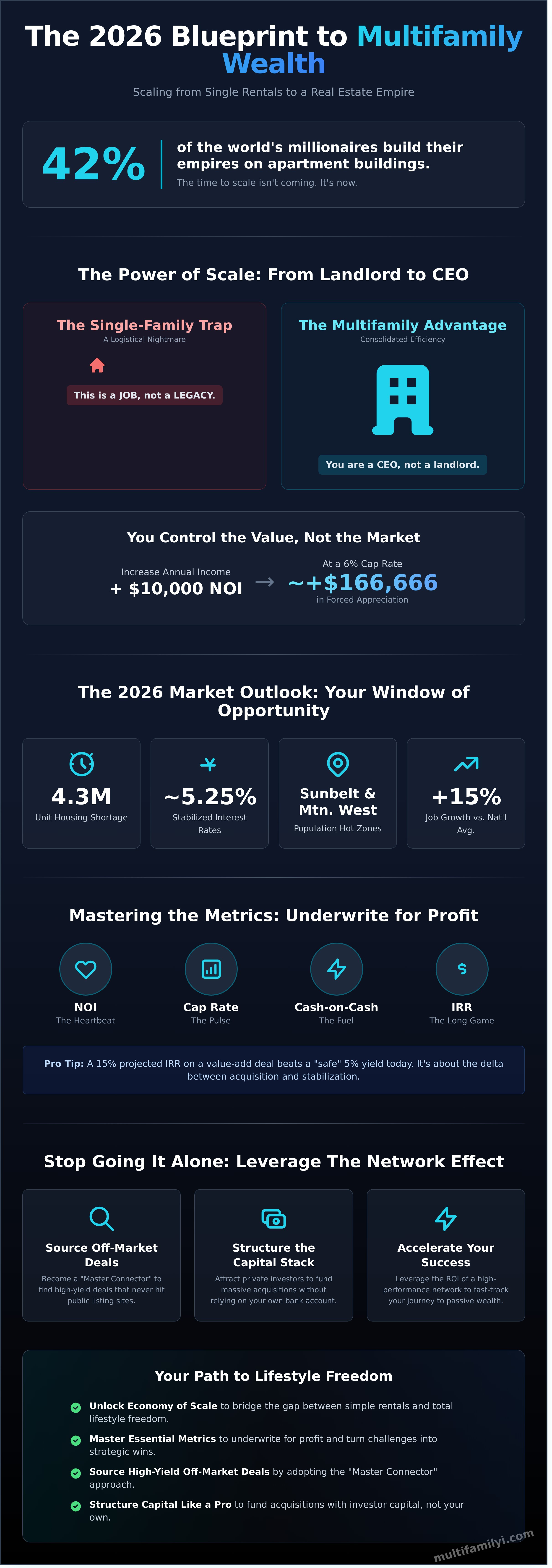
The 2026 market outlook confirms that rental housing remains the most recession-resistant asset class in existence. While other sectors face volatility, the fundamental need for shelter is unwavering. By January 2026, the cumulative housing shortage in the United States reached a staggering 4.3 million units according to data from the National Multifamily Housing Council. You aren't just buying a building; you're providing a solution to a national crisis. This demand creates a floor for your investment, ensuring that your path to passive wealth is protected by fundamental economic drivers.
The Multifamily Advantage: Scaling Beyond 1-4 Units
Scaling beyond the 1-4 unit residential limit unlocks the power of commercial valuation. In the single-family world, your property value is capped by what the neighbor’s house sold for. Commercial assets are different. They are valued based on Net Operating Income (NOI). If you increase the annual income or trim utility waste by $10,000 on a 50-unit building, you aren't just making extra cash. At a 6% cap rate, that $10,000 in NOI adds approximately $166,666 in immediate forced appreciation. You control the value, not the market.
Tax benefits at this scale are unmatched. Through cost segregation and accelerated depreciation, investors can often offset 80% or more of their rental income in the first few years. These are not just "deductions"; they are strategic tools that allow you to keep more of what you earn. Investing in multifamily real estate allows you to build a fortress of wealth that is shielded from the tax burdens that plague high-income earners in other industries.
The 2026 Reality: Navigating the New Economic Landscape
Real estate investors in 2026 have successfully moved past the rate-hike volatility of the early 2020s. With interest rates stabilizing around the 5.25% mark, the "high rate" elephant in the room has become the new baseline for predictable growth. Historical context shows that wealth is built during periods of stabilization, not just during record lows. We are currently seeing massive population shifts toward "hot zones" in the Sunbelt and Mountain West, where job growth is outpacing the national average by 15%.
Institutional capital is currently pouring into these regions, but the individual entrepreneur still holds a distinct advantage: agility. While large funds require months of red tape to approve a deal, a streamlined network of private investors can identify, underwrite, and close on a value-add opportunity in 45 days. By 2026, the gap between those who own assets and those who rent them has widened. Positioning yourself on the side of ownership is the only way to dominate this economic cycle and secure your professional mastery.
Mastering the Math: Underwriting for Profit in Any Market
Mastering the math is how you dominate the 2026 market. You can't rely on luck. You must rely on the numbers. Net Operating Income (NOI) is your heartbeat. Cap Rate is your pulse. Cash-on-Cash Return is your fuel. If you're serious about investing in multifamily real estate, you must see past the sticker price. Beginners often flee from "negative cash flow" deals. Experienced syndicators see opportunity. They look at the bridge debt and the three-year stabilization plan. They know that a 15% internal rate of return (IRR) beats a 5% yield today every single time. It's about the delta between acquisition and stabilization.
Your underwriting must account for the macro environment. Data from the U.S. Treasury on Rent, House Prices, and Demographics shows that supply constraints drive long-term value even when short-term rates fluctuate. Don't let a temporary dip scare you. Instead, use the "Attorney’s Edge" by modeling legal contingencies. This means budgeting for 5% higher legal reserves to handle shifting compliance landscapes or eviction delays. Spot the hidden killers early. Property tax resets in states like Florida or Texas can spike your expenses by 25% overnight. If you didn't model the post-sale assessment, your deal is dead before it starts.
The "Attorney’s Edge" also involves legal contingency modeling for lease audits. If 10% of your leases have non-standard clauses, your exit could be delayed. Professional investors audit these during due diligence to prevent "phantom" income from inflating the NOI. Additionally, watch for insurance premiums. In late 2025, many operators saw 20% increases in coastal markets. Your underwriting must factor in these escalations to ensure your investing in multifamily real estate journey doesn't hit a wall. Precision isn't optional; it's your protection.
The Deal Analyzer Framework
Stop guessing. Start calculating. A professional framework determines value based on a trailing-12 (T12) profit and loss statement, not a broker’s dreams. You can use the Multifamily Analyzer to vet these opportunities in under five minutes. Always run a sensitivity analysis. If interest rates climb 1% or 2% during your hold period, does your debt coverage ratio stay above 1.20? If not, walk away. You need a margin of safety to protect your investors and your reputation.
Value-Add Strategies: Increasing NOI Without Raising Rents
Force appreciation by attacking the expense line. Implementing a Ratio Utility Billing System (RUBS) can recover 80% to 90% of water and sewer costs. This shifts the burden from the owner to the user. Next, unlock ancillary income. High-speed tech packages or reserved parking spots can add $50 per door monthly. In a 100-unit complex at a 5% cap rate, that $60,000 annual increase in NOI adds $1.2 million in property value. Efficiency scales wealth. You can scale your portfolio faster by focusing on these operational wins. Reduce your maintenance lag from 48 hours to 24 hours. Lower turnover by 10%. These small moves create massive exits.
Finding the "Unfindable": Proactive Off-Market Deal Sourcing
Stop wasting time on LoopNet or the MLS. By the time a 50-unit complex hits a public portal, the cap rate has already been squeezed by institutional bidding wars. In 2026, the most successful investors realize that 82% of high-yield deals happen behind closed doors. To scale your portfolio, you must transition from a passive browser to a proactive hunter. This requires a "Master Connector" mindset where you prioritize relationships over listings. Investing in multifamily real estate at an elite level means finding distressed owners before they even realize they're ready to sell. You must leverage local intelligence, such as tracking municipal code violations or monitoring 90-day delinquency lists, to identify targets. Direct-to-owner marketing in 2026 utilizes AI-driven skip tracing to reach decision-makers via personalized video messages and hyper-targeted digital ads. This approach bypasses the noise and puts you directly at the negotiation table with the power to dictate terms. Accelerate your growth by targeting the "tired landlord" demographic, specifically those who've held assets for more than 15 years and are facing significant capital expenditure requirements.
Building Your Broker and Wholesaler Network
Brokers are the gatekeepers to the "Pocket Listing," which is an asset sold before it ever touches the open market. To get on the first-call list, you must demonstrate 100% certainty of execution. Send brokers a one-page "Investor Buy Box" that specifies your target submarkets, minimum unit counts, and vintage preferences. When you submit a Letter of Intent (LOI), keep it clean; avoid excessive contingencies that signal weakness or indecision. Successful members of The Network often reference a guide to multifamily investing to ensure their underwriting matches 2026 market benchmarks. Closing a single $4.5 million deal with a local broker ensures you stay top-of-mind for the next ten opportunities. Don't just ask for deals; provide value by sharing market data or referring vendors to build a reciprocal partnership.
The Power of Owner Financing
Retiring owners are your greatest untapped resource for investing in multifamily real estate without the friction of traditional banks. With over 10,000 Baby Boomers reaching retirement age daily, many want to offload management headaches while maintaining a steady monthly check. This is where you unlock massive scale through seller carry-backs. Structure a win-win by offering the seller a slightly higher purchase price in exchange for a 4.5% interest rate, which is often lower than current commercial bank debt. Always use a third-party note servicer to handle payments and include a "Substitution of Collateral" clause to maintain your long-term flexibility. This strategy creates Passive Wealth for the seller through interest income and provides you with a high-leverage entry point. Ensure your legal team reviews the Deed of Trust to protect all parties, turning a simple transaction into a sophisticated wealth-building engine.
The Capital Stack: Funding and Structuring Your Acquisition
Mastering the capital stack is the fundamental difference between owning a job and owning a legacy. In 2026, investing in multifamily real estate requires a surgical approach to how you layer your financing. The stack typically starts with senior debt, which covers 65% to 75% of the asset value. Above that, savvy operators often utilize mezzanine debt or preferred equity to bridge the gap between the loan and the common equity. This top layer is where you and your partners reside. You must understand these layers to protect your downside while maximizing the velocity of your capital.
Raising capital isn't about begging for checks; it's about providing a vehicle for passive wealth. You aren't a salesman. You're a deal sponsor offering a solution to investors tired of stock market volatility. To stay compliant, you must operate under SEC Regulation D. Most syndicators utilize Rule 506(b) to raise from sophisticated investors they have pre-existing relationships with. Others choose Rule 506(c), which allows for general solicitation but limits investors to verified accredited individuals. Structuring the GP/LP split correctly is your most powerful retention tool. A standard 80/20 split with an 8% preferred return ensures your investors receive their yield before you participate in the profits. This alignment of interests is what builds a multi-generational investor base.
Raising Private Money for Apartments
Your investor pitch deck must be a masterclass in transparency and data. Include 2025 submarket absorption rates and 60 month rent growth projections to prove your thesis. While a "Friends and Family" round can fund your first 20 unit deal, scaling to 200 units requires professional private equity standards. Establish your authority by showcasing your education and the strength of your property management partners. Investors don't just buy buildings; they buy into your ability to execute a business plan under pressure. If you lack a track record, leverage the credibility of a mentor to bridge the gap.
Debt Strategies for 2026
Agency debt through Fannie Mae and Freddie Mac remains the gold standard for stability. These non-recourse loans offer 10 year terms that effectively hedge against future interest rate swings. For heavy value-add plays, bridge loans provide the 24 to 36 months of flexibility needed to renovate and reposition an underperforming asset. Once you increase the Net Operating Income by 18% through strategic upgrades, you can execute the MF-BRRRS model. Refinance into permanent debt, return the initial capital to your investors, and hold the asset for infinite returns. This strategy allows you to scale your portfolio without constantly seeking new equity.
Stop playing small and start dominating the market. Join the network and scale your capital raising today.
Accelerate Your Success: The Role of the Multifamily Network
Stop trying to be a lone wolf. In the 2026 real estate landscape, where property taxes in high-growth states like Texas or Florida can spike 22% in a single assessment cycle, isolation is your biggest liability. Trying to "go it alone" is the most expensive mistake you'll ever make. One miscalculation in a utility audit or a missed clause in a commercial loan document can vaporize $125,000 of your equity before you even collect your first rent check. Successful investors don't guess; they leverage the collective intelligence of a proven tribe.
The ROI of mentorship is undeniable. Think of a $10,000 investment in a high-level network as an insurance policy against a $100,000 rookie error. When you're investing in multifamily real estate, your network functions as a tangible asset on your balance sheet. It provides you with off-market deal flow that never hits the public portals and connects you with bridge lenders offering rates 40 to 60 basis points lower than retail quotes. Proximity to power is the ultimate shortcut to scaling your portfolio.
The Multifamily Intelligence Mentorship Advantage
You need aggressive, real-time feedback on your deal structures before you sign the contract. Most new investors fail because their underwriting is based on outdated 2024 data. By applying the principles from the 5-Day Multifamily Challenge, you stress-test your assumptions against 2026 market realities. You'll work alongside high-performing peers who are closing 40 to 150-unit deals, ensuring your first acquisition is a strategic win rather than a financial burden.
Moving from Investor to Asset Manager
True wealth requires a fundamental shift in your identity. You aren't just buying buildings; you're engineering a scalable business. This "Multifamily Mindset" focuses on institutional-grade systems that allow the asset to perform without your constant supervision. If you're still handling individual maintenance tickets, you've bought a job, not an investment. To truly scale and achieve passive wealth, you must Join the Multifamily Investing Academy and master the art of syndication. This is how you dominate your market and secure total lifestyle freedom.
Your 90-day roadmap to closing your first (or next) apartment deal starts today:
Days 1-30: Solidify your "Power Team" including a SEC attorney, a specialized commercial broker, and a third-party property manager with at least 1,000 units already under management.
Days 31-60: Underwrite a minimum of 20 properties. Your goal is to identify one "diamond" deal that hits a 15% internal rate of return (IRR) target even in a conservative exit scenario.
Days 61-90: Submit at least five Letters of Intent (LOIs). Use your network to secure a debt quote and move into the due diligence phase with the confidence of a seasoned pro.
Building that team with the right local expertise is non-negotiable. In competitive markets like Southern California, for instance, a specialized agency can be your biggest asset. To see what that kind of dedicated support looks like, visit County Properties.
Don't wait for the "perfect" market conditions to start investing in multifamily real estate. The market moves fast, and those with the strongest network move faster. Secure your seat at the table, leverage the blueprints provided by the masters, and start building your legacy now.
Secure Your Financial Legacy in 2026
The window for massive growth in 2026 is wide open. You've now seen how proactive off-market sourcing and rigorous underwriting transform a simple deal into a high-octane cash-flow engine. Success isn't a happy accident; it's the result of mastering the capital stack and leveraging a high-level network that identifies opportunities before they ever hit the public market. By investing in multifamily real estate, you aren't just buying buildings. You're securing your total lifestyle freedom and professional mastery.
While building your real estate portfolio secures your financial future, it's equally important to protect your family's well-being along the way. Many investors take the simple step of getting instant term life insurance quotes to ensure their loved ones and business partners are covered.
Don't try to navigate this complex landscape alone. Charles Dobens, known as The Multifamily Attorney, has spent over 10 years providing specialized mentorship to help investors scale their portfolios with confidence. You need the right tools to win in this competitive environment. Our proprietary Multifamily Analyzer software takes the guesswork out of the math, ensuring every acquisition is a calculated step toward your ultimate goals. It's time to stop watching from the sidelines and start building your empire with the backing of a proven system.
Your path to generational wealth and professional excellence starts today. We'll see you inside the network.
Frequently Asked Questions
Is investing in multifamily real estate still profitable with high interest rates?
Yes, multifamily remains a powerhouse for profit because rent growth and forced appreciation consistently outpace debt costs. Even with interest rates hovering at 6.5% in 2026, savvy investors use bridge loans or agency debt to lock in profitable spreads. Focus on properties with a 3% rent growth cushion to maintain healthy cash flow. You win by focusing on the Net Operating Income rather than just the loan percentage.
How much money do I need to start investing in multifamily properties?
You need $50,000 to $100,000 to enter a high-level syndication as a passive investor. If you're buying a 4-unit residential property, expect a 3.5% down payment for FHA loans or 20% for conventional financing. For a $1.2 million asset, that's a $240,000 entry point. Scale your capital faster by pooling resources with partners in your network to tackle larger, more stable commercial assets.
What is the difference between a residential and a commercial multifamily property?
The primary difference is the unit count and the method the bank uses for valuation. Residential multifamily covers 2 to 4 units and relies on comparable sales data from the last 6 months. Commercial multifamily involves 5 or more units and is valued based on the income it generates. Use a cap rate of 5.8% to 6.2% to calculate value on these larger, income-driven deals.
Can I invest in multifamily real estate while working a full-time job?
You can absolutely build passive wealth while working 40 hours a week by participating in syndications or hiring third-party property managers. Passive investors typically spend 5 hours reviewing a deal before committing capital and then let professional teams handle the daily operations. This strategy allows you to leverage the expertise of others while keeping your career income. Investing in multifamily real estate doesn't require you to be a landlord.
What are the biggest risks when buying an apartment building?
Interest rate volatility and unexpected vacancy spikes are the two primary risks you must manage. A vacancy rate exceeding 10% can quickly erode your debt service coverage ratio and stall your growth. Protect your downside by purchasing interest rate caps on floating-rate debt and maintaining a 6-month capital reserve for emergency repairs. Always stress-test your pro forma against a 12% drop in market rents.
How do I find off-market multifamily deals in a competitive market?
Secure off-market deals by building direct relationships with commercial brokers who control 85% of the inventory. Send targeted direct mail campaigns to owners who have held their properties for 7 or more years; these campaigns often see a 2% response rate. Use tools like Reonomy to pull owner contact data and skip-trace their phone numbers. Persistence in your follow-up is where the real deal flow happens.
What is a good cap rate for a multifamily investment in 2026?
A strong cap rate in 2026 typically falls between 5.5% and 7.0% depending on the asset class and geographic location. Class A properties in high-growth markets like Charlotte or Nashville might trade at 5.3%, while Class C value-add plays should target 7.5% or higher. Don't just chase the highest number; focus on the 200-basis point spread between your cap rate and your interest rate to ensure positive leverage.
Do I need an LLC to buy a multifamily property?
You should always use an LLC to shield your personal assets from property-level liabilities and lawsuits. Most professional investors set up a separate LLC for each 5-unit building to isolate risk and protect the rest of their portfolio. This structure also simplifies the distribution of K-1 tax forms to your investment partners. Consulting with a business law firm like
and a tax professional is crucial to ensure your entity structure is optimized.
For investors with international holdings or family ties, particularly between the U.S. and Israel, asset protection takes on additional layers of complexity. Navigating cross-border legal challenges is crucial for safeguarding your legacy, and to that end, you can discover Israel Cross Border Law Firm.


Comments