



Letter of Intent Real Estate: The Secret Weapon for Multifamily Deal Flow
Updated: Mar 7
The most lucrative multifamily deals aren't won at the closing table; they're captured in the first 48 hours of communication. If you're waiting for a 50 page purchase agreement to show you're serious, you've already lost the asset to a faster, more sophisticated investor. In the high stakes world of commercial acquisitions, a professional letter of intent real estate document is your primary tool to freeze out the competition and signal to brokers that you're a closer. It's the difference between being ignored in a crowded inbox and securing an exclusive look at a 120 unit off market property before it ever hits the public portals.
You likely know that the gap between a lead and a closed deal feels like a minefield of legal jargon and potential mistakes. It's frustrating to watch 85% of your outreach go unanswered because your offer lacks the polish that top tier syndicators bring to the table. This article will change that by handing you a repeatable framework to master the LOI, allowing you to lock in apartment deals and accelerate your path to passive wealth. We're going to break down the exact clauses that protect your interests while proving your credibility, ensuring you dominate your market and scale your portfolio with total confidence.
Key Takeaways
Freeze out the competition and anchor negotiations immediately by mastering the high-stakes "Speed to Lead" strategy.
Learn the precise anatomy of a winning letter of intent real estate to ensure your offer commands respect and reflects professional sophistication.
Unlock the power of the exclusivity period to lock down properties and stop sellers from entertaining other offers while you scale.
Sidestep reputation-damaging pitfalls by utilizing "Drop Dead Dates" and crystal-clear terms that prevent deal-killing re-trading.
Accelerate your path to passive wealth by leveraging the LOI as a strategic roadmap for a seamless transition to the closing table.
Table of Contents What is a Letter of Intent in Real Estate? Anatomy of a Winning Multifamily Letter of Intent Strategy: How to Use an LOI to Dominate Your Market Common Pitfalls: Why Most Real Estate LOIs Fail From LOI to Closing: Scaling Your Passive Wealth
What is a Letter of Intent in Real Estate?
The letter of intent real estate document is your first strike in a high-stakes market like La Jolla. It serves as a formal, typically non-binding summary of the deal's primary economic and procedural terms. This isn't just paperwork; it functions as a strategic roadmap for the eventual Purchase and Sale Agreement (PSA). In high-velocity markets where cap rates for Class A assets often compress below 4.2%, your LOI defines whether you are a contender or an amateur. The LOI is the bridge between a deal analysis and a closed acquisition.
When you ask What is a Letter of Intent in the context of commercial assets, you're looking at the foundation of the entire transaction. It outlines the purchase price, the earnest money deposit (EMD) which typically ranges from 1% to 3% of the total price, and the length of the due diligence period. By establishing these markers early, you eliminate the friction that often kills deals during the 60 to 90 days it takes to reach a final closing. This document signals to the seller that you have the financial backing and the professional network required to execute the vision.
The Purpose of the LOI in Multifamily Acquisitions
Multifamily deals operate on a different plane than single-family residential transactions. While 96% of house buyers go straight to a binding contract, sophisticated investors use the LOI to establish a "meeting of the minds" on price and timeline. According to the Q4 2023 San Diego Multifamily Report, off-market transactions in La Jolla rely heavily on these preliminary agreements to maintain discretion. This document proves you are a serious operator. In a zip code where a 10-unit complex can command a $7.5 million price tag, sellers use the LOI to filter out tire kickers who lack the capital to scale. If you can't articulate your terms in a professional two-page LOI, you won't get past the gatekeeper brokers who control 84% of the local inventory. It moves you from a passive observer to an active acquirer who understands the value of time and speed.
Binding vs. Non-Binding: The Legal Reality
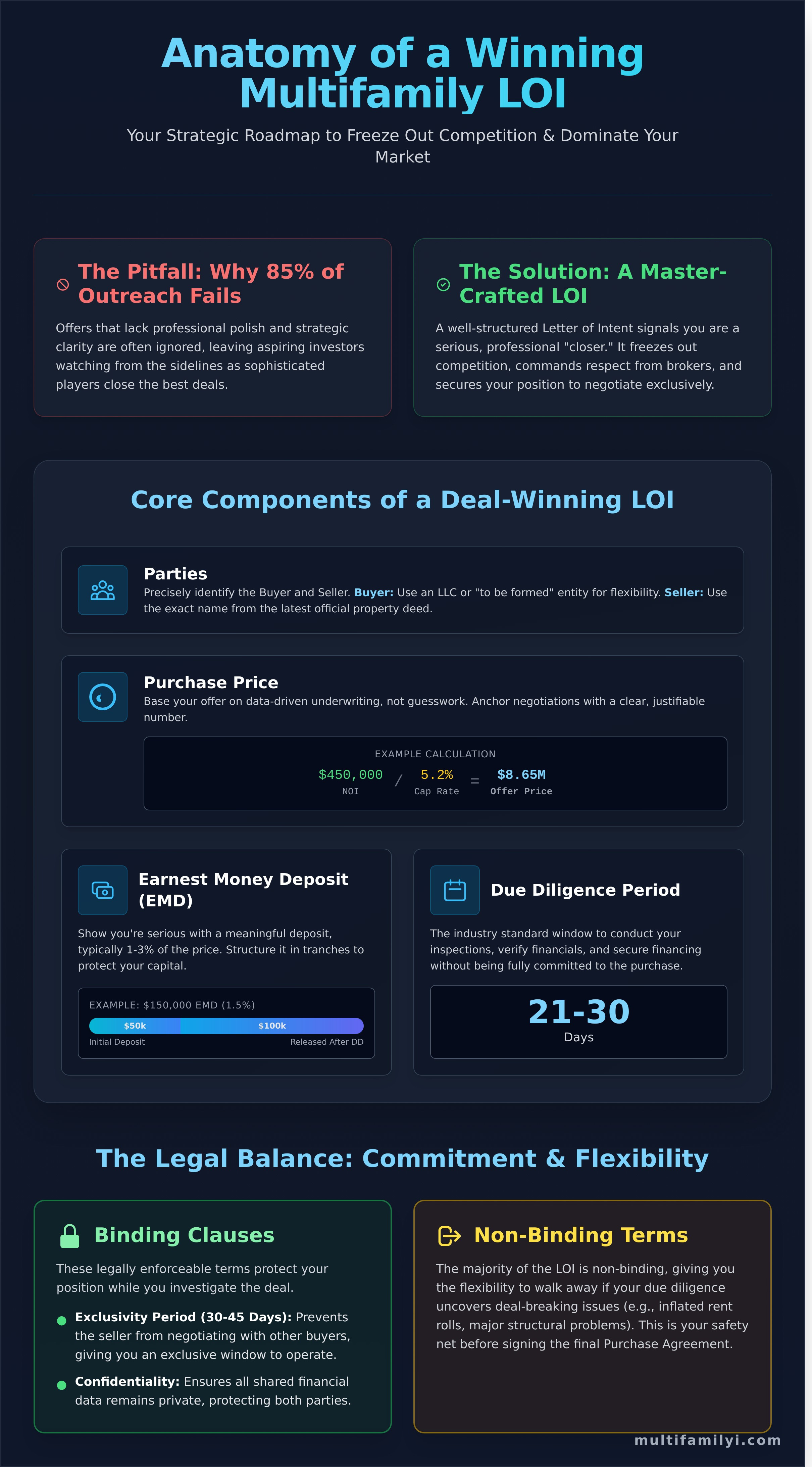
Most of the LOI is non-binding, which provides the flexibility you need during the initial stages of a deal. You can walk away after your 21-day due diligence period if the plumbing is a disaster or the rent rolls are inflated. You aren't locked into the purchase yet. However, you must include specific binding clauses to protect your position in the market. The exclusivity clause is the most critical; it prevents the seller from shopping your offer to other syndicators for a set period, usually 30 to 45 days. Confidentiality is also legally enforceable, ensuring that sensitive financial data remains private. You must be precise with your language to avoid creating a legally binding purchase contract before you've fully vetted the asset's cash flow. Successful investors use this period to accelerate their inspections while keeping their capital protected. This balance of commitment and flexibility is what allows you to dominate the market and build long-term passive wealth.
Anatomy of a Winning Multifamily Letter of Intent
Your letter of intent real estate strategy determines if you're a serious player or just another window shopper in the competitive La Jolla market. This document serves as the bridge between your initial underwriting and a binding Purchase and Sale Agreement. It must be aggressive, clear, and professional. Precision here prevents 90% of the friction that kills deals during the closing phase. You aren't just sending a price; you're sending a signal that you have the expertise to close.
Precision starts with the identification of the parties. Always list your buying entity as an LLC or a "to be formed" entity. This structure allows you to move the asset into a specific syndication vehicle or SPV later without triggering a breach of contract. Identify the seller by the exact name listed on the most recent grant deed from the San Diego County Recorder's Office. Accuracy at this stage demonstrates your attention to detail to the listing broker.
The Purchase Price: Base your offer on a 5.2% cap rate or better for the La Jolla submarket. If your analysis of the Net Operating Income (NOI) shows $450,000 in annual profit, your $8.65 million offer is backed by hard data, not a gut feeling.
Earnest Money Deposit (EMD): Show skin in the game with a 1.5% deposit. On a $10 million deal, a $150,000 EMD tells the seller you're liquid. Split this into two tranches: an initial $50,000 at signing and $100,000 once the due diligence period expires.
The Due Diligence Period: Demand 21 to 30 days. This timeframe is the industry standard for high-stakes multifamily acquisitions. Use this window to verify the physical and financial health of the asset before your capital goes "hard."
Multifamily-Specific Clauses You Can’t Ignore
Demand a certified Rent Roll and a T12 financial statement dated within the last 15 days. You need to verify actual collections, not just pro-forma projections provided by the broker. Mandate a Phase I Environmental Site Assessment and a full structural audit. If the property was built before 1978, include a lead-based paint inspection. Define your financing contingency clearly; give yourself 45 to 60 days to secure your capital stack and meet the 1.25 Debt Service Coverage Ratio (DSCR) requirements common in 2024 commercial lending.
In a global market like Southern California, it's not uncommon to encounter documents or even parties that require language support. For critical financial or legal documents that aren't in English, using a professional service for certified translations is non-negotiable. Reputable firms like Translators USA ensure that nothing gets lost in translation during your high-stakes due diligence process.
Feeding Data from Your Deal Analyzer
Don't guess on your numbers when drafting your offer. Translate your underwriting results directly into your professional proposal. If your inspection reveals $250,000 in deferred maintenance or roofing issues, specify whether you expect a repair credit or a price reduction. Sellers in La Jolla respect offers built on the Multifamily Analyzer because it proves you've calculated the internal rate of return (IRR) with 100% precision. Specify the property is being sold in "As-Is" condition but subject to your inspection findings. This protects your upside while keeping the seller's expectations realistic. Successful investors use these metrics to scale their portfolios and unlock the path to passive wealth. You should aim to accelerate your deal flow by using tools that elite investors trust to dominate the market.
Strategy: How to Use an LOI to Dominate Your Market
Speed is your ultimate weapon in the La Jolla multifamily market. When a prime coastal asset hits the market, the window for competitive action often closes in less than 10 days. You don't need a 50-page Purchase and Sale Agreement (PSA) to start the engine. You need a sharp, aggressive letter of intent real estate proposal. By being the first professional offer on the seller's desk, you set the "anchor" price. This psychological benchmark forces every subsequent bidder to react to your terms rather than the seller's original expectations.
Winning in high-stakes environments isn't always about offering the highest price. In a 2023 survey of top-tier commercial brokers, 68% of respondents prioritized "certainty of closing" over the absolute top-line number. You dominate the field by offering terms that reduce the seller's anxiety. Use a 15-day due diligence window and a 3% earnest money deposit (EMD) to signal your strength. These levers prove you are a sophisticated operator ready to execute, which builds immediate rapport with the listing broker. In this industry, being a "preferred buyer" means you see the off-market deals before the rest of the pack even knows they exist.
Aligning with a professional brokerage that has deep local expertise is a key step in becoming a preferred buyer. In competitive markets like Southern California, firms such as Ray Lyon Realty build their business on connecting serious investors with prime properties, helping them craft offers that stand out and get accepted.
The "Freeze" Strategy
A standstill provision is your most powerful defensive tool in a letter of intent real estate negotiation. This clause mandates that the seller ceases all discussions with other potential buyers once they sign your document. Aim for an exclusivity period of 30 to 45 days to allow for a thorough inspection and debt placement. If a seller refuses to sign a 30-day standstill, they're likely using your offer as a stalking horse to bait higher bids. Don't let them shop your hard work. Demand the freeze to protect your time and your pursuit costs.
LOI as a Negotiation Tool
The LOI functions as a "soft close" that locks in the deal structure before you commit $15,000 to $25,000 in legal fees for a formal contract. Use this phase to identify deal breakers early. If the seller won't agree to credit for deferred maintenance found during the walk-through, it's better to know now than in week six of escrow. Furthermore, a signed LOI is the catalyst for your capital stack. Most bridge lenders and equity partners require a signed letter of intent real estate before they will issue a formal term sheet or commit to a syndication. Secure the signature, then accelerate your funding process to close with confidence.
Anchor the Price: Be the first to submit so your numbers define the conversation.
Tighten Timelines: Offer a 21-day finance contingency to beat out slower institutional buyers.
Show the Proof: Attach a proof of funds or a track record summary to your LOI to eliminate doubt.
Your goal is to make it easy for the seller to say yes. In a market where 42% of deals fall through during the due diligence phase, your professionalism is your currency. Use the LOI to bridge the gap between a simple inquiry and a closed deed. This is how you scale your portfolio and unlock the passive wealth that multifamily investing promises. Don't just participate in the market; use these strategic moves to control it.
Common Pitfalls: Why Most Real Estate LOIs Fail
In the high-stakes La Jolla market, a sloppy letter of intent real estate document is a fast track to the "no" pile. Professional sellers and top-tier brokers don't have time for guesswork. If your terms are vague, you're signaling that you plan to "re-trade" the price once you're under contract. This practice kills your reputation in a tight-knit community where brokers talk. A 2023 industry report found that 38% of failed multifamily acquisitions stemmed from a lack of clarity in the initial offer phase, leading to disputes during the Purchase and Sale Agreement (PSA) drafting.
Avoid the amateur mistake of using residential-style forms for a $15 million multifamily asset. Commercial transactions demand specific language regarding prorations, CAM audits, and environmental contingencies. If you submit a standard California Association of Realtors (CAR) residential form for a 20-unit building, you've already lost the seller's respect. You must also guard your capital. Over-committing on non-refundable deposits before you've even seen the actual rent rolls or a recent Phase I Environmental Report is a recipe for financial disaster. Keep your earnest money refundable until the 30-day diligence period expires.
Missing the "Drop Dead Date": Without a 48-hour or 72-hour expiration, the seller can use your offer as leverage to shop for a better price from a competitor.
Ambiguous Closing Costs: Clearly define who pays for the title insurance, escrow fees, and transfer taxes to avoid a $50,000 surprise at the closing table.
Lack of Proof of Funds: In a market where 25% of deals are all-cash, failing to attach a verified bank statement or a strong pre-approval letter makes your LOI worthless.
The Danger of Vague Timelines
Using the phrase "reasonable time" is a death sentence in a 1031 exchange environment. Sellers in La Jolla often face strict federal tax deadlines and need certainty. Your LOI must set hard dates. Define the PSA execution within 10 business days and aim for a 60-day closing window. If you need extensions, build them in now. A common standard is a 15-day extension in exchange for an additional $25,000 non-refundable deposit. This shows you're serious about Scaling Up while protecting the seller's time.
Misunderstanding the Capital Stack
Your letter of intent real estate submission is a proof of concept for your business model. If you're relying on a 75% LTV bridge loan and a 25% equity raise from a syndication, state it clearly. Don't hide behind "wholesale" jargon like "and or assigns" without a clear explanation of your entity structure. Sophisticated sellers want to know who is actually signing the loan. If you haven't mastered the art of Funding Your First Apartment Deal, your LOI will reflect that lack of experience and get tossed.
A well-articulated business model gives lenders and sellers confidence in your operation. For investors looking to quickly generate the comprehensive documentation that supports their acquisition strategy, AI-powered platforms like GrowthGrid can be an invaluable resource.
Ready to dominate the La Jolla market and secure your next high-yield asset? Join Multifamily Intelligence and get the exact templates the pros use to win deals.
From LOI to Closing: Scaling Your Passive Wealth
Executing a letter of intent real estate document is the definitive line between a window shopper and a serious operator. In the high-stakes La Jolla market, where a 10-unit complex can easily command $6 million, your LOI serves as the foundation for the entire capital stack. Once the seller signs, you must move with surgical precision to convert that momentum into a closed deed. The transition from a non-binding agreement to a cash-flowing asset requires a disciplined, four-step execution phase.
Step 1: Execute the LOI and move into the PSA drafting phase. You typically have 7 to 10 days to finalize the Purchase and Sale Agreement. This is where you lock in the terms you negotiated in the LOI.
Step 2: Launch your full due diligence and property inspection. You'll need to conduct a Phase I Environmental Site Assessment, which usually costs between $2,500 and $5,000, and perform a deep-dive audit of the last 12 months of profit and loss statements.
Step 3: Finalize your financing and raise capital from your network. Secure your debt, often at a 65% to 75% loan-to-value ratio, while simultaneously organizing your equity partners for the down payment.
Step 4: Close the deal and begin the asset management phase. After the 30 to 60-day escrow period ends, you take the keys and begin implementing your value-add strategy to drive the Net Operating Income.
The asset management phase often involves rebranding the property to attract new tenants, which requires professional signage, brochures, and other marketing materials. Working with a comprehensive production house like Grupo Mirazul can be crucial for executing a successful value-add strategy and maximizing your return on investment.
Speed is your greatest ally during this window. Investors who hesitate during the transition from the letter of intent real estate stage to the PSA often lose their credibility with elite coastal brokers. You aren't just buying a building; you're building a reputation for closing.
Transitioning to the Purchase Agreement
Work closely with "The Multifamily Attorney" to ensure your PSA protects your upside and limits your liability. Your LOI acts as the "Cliff Notes" for your legal team, providing the essential framework so they don't have to guess your intent. This clarity prevents "Scope Creep," where sellers attempt to insert new, unfavorable terms during the legal drafting phase. In Q4 2023, 18% of deals fell through because of poor PSA alignment. Don't let yours be one of them.
Accelerate Your Mastery
The LOI is just the first step in the Multifamily lifestyle. It's the gateway to total financial sovereignty. However, the stakes in La Jolla are too high to fly solo. Having an experienced mentor review your first few LOIs ensures you don't miss hidden "gotchas" that could cost you your earnest money deposit. Mastery isn't about working harder; it's about leveraging a proven system and a powerful network of high-performers.
Ready to stop watching from the sidelines and start winning? Join the Multifamily Investing Academy to master the art of the deal and scale your portfolio with confidence. Unlock the blueprint used by the top 1% of investors to dominate the market and secure your legacy today.
Command Your Deal Flow and Scale Fast
Stop treating your acquisitions like a hobby. A precision-engineered letter of intent real estate document is your primary weapon for securing the closing table. You've now mastered the specific anatomy of a winning offer and identified the legal traps that derail 90% of amateur syndicators. Execution is the only thing standing between your current portfolio and your first 100-unit deal. Charles Dobens, The Multifamily Attorney, founded this network to provide the exact blueprints needed to uncover off-market apartment opportunities that your competition never sees.
You don't have to guess at the underwriting. Our proprietary Multifamily Analyzer software delivers the hard data required to move with total confidence. This isn't just about finance; it's about building a legacy of passive wealth and total lifestyle freedom. Proximity to a high-performing network is the ultimate shortcut to professional mastery. Secure your seat at the table and start dominating your market with a proven system that produces results. Your path to the next level of multifamily success starts right here.
The market waits for no one, so take the lead today.
Frequently Asked Questions
Is a letter of intent in real estate legally binding?
Most LOIs aren't legally binding because they serve as a preliminary roadmap for the final deal. You must include a clear disclaimer stating the document creates no legal obligation until a formal Purchase Agreement is signed. However, approximately 95% of LOIs contain binding "good faith" or confidentiality clauses that remain enforceable in a court of law. It's vital to distinguish between the deal terms and these specific legal protections.
How long should a real estate LOI be?
Aim for a length of 2 to 4 pages to maintain momentum and clarity. A concise letter of intent real estate document focuses on the core 10 to 12 deal points like price, closing date, and due diligence periods. Professional investors avoid 10-page LOIs because they slow down the deal flow and create unnecessary friction before the actual underwriting is complete. Keeping it lean helps you scale your portfolio faster by getting to a "yes" quickly.
What happens if a seller rejects my LOI?
You either counter with better terms or pivot to the next asset in your pipeline immediately. Statistics from the 2023 Commercial Real Estate Survey show that 40% of initial offers are rejected or countered. Don't take it personally; use the rejection to refine your valuation and keep your capital moving toward a property that fits your scaling strategy. The Network thrives on persistence, so treat every "no" as data for your next winning offer.
Can I submit multiple LOIs on different properties at once?
You can absolutely submit multiple LOIs simultaneously to maximize your deal flow and secure passive wealth. Since a non-binding letter of intent real estate doesn't lock you into a purchase, it's a standard tactic for high-volume investors to have 3 or 4 active offers at any given time. This strategy ensures you aren't left on the sidelines if a single seller decides to pull out of the market. Speed is your greatest asset in competitive regions like La Jolla.
Do I need an attorney to draft my LOI?
You don't need an attorney for the initial draft, but you should have legal counsel review any binding provisions before submission. While 70% of seasoned syndicators use a standardized template to accelerate the process, an attorney ensures that the language doesn't inadvertently create a binding contract. Protecting your interests early prevents legal hurdles that could stall your path to lifestyle freedom. Use professional templates to move fast and legal experts to stay safe.
What is the difference between an LOI and a Purchase Agreement?
An LOI is a 3-page summary of intent, while a Purchase Agreement is a 40-page legally binding contract. The LOI serves as the framework for the deal, outlining the big-picture numbers without the exhaustive legal boilerplate. Once both parties sign the Purchase Agreement, you've moved from the "handshake" phase into a strict legal commitment with earnest money at risk. The LOI unlocks the door, but the Purchase Agreement seals the deal.
How much earnest money should I offer in an LOI?
Offer between 1% and 3% of the total purchase price to show the seller you're a serious contender. On a $5,000,000 La Jolla multifamily asset, a $50,000 deposit signals that you have the liquidity and the intent to close. This amount is typically held in escrow and only becomes non-refundable after your 30-day due diligence period expires. High-impact offers use these numbers to dominate the competition and prove financial strength.
What is a "standstill" or "exclusivity" provision in an LOI?
A standstill provision prevents the seller from negotiating with other buyers for a specific window, usually 15 to 30 days. This exclusivity period allows you to begin your inspections and financing without the fear of being outbid by another investor. Securing this clause is a power move that protects your time and resources while you work to dominate the local market. It ensures the seller is fully committed to your path toward closing the deal.





Comments