



Multifamily Investing in 2026: The Blueprint for Scaling to Passive Wealth
Are you tired of analyzing the same overpriced deals from brokers-the ones promising negative cash flow from day one? In a market where capital is skeptical and the fear of overpaying is paralyzing the competition, most investors will stay on the sidelines. But the elite operators see this economic shift for what it is: the single greatest opportunity to build a legacy of Passive Wealth.
Forget the old playbook. This is your 2026 blueprint to dominate multifamily investing. We are handing you the attorney-led framework our top members in The Network use to unlock off-market alpha, secure creative owner financing, and scale their portfolios with precision. Prepare to master the strategies that find, analyze, and close the deals that will accelerate your journey to total lifestyle freedom. It’s time to stop chasing the market and start creating it.
Key Takeaways
Unlock deal flow by mastering creative financing strategies like owner financing and Master Lease Options, bypassing the high-interest rate trap of traditional banks.
Implement the "3-Minute Triage" framework to instantly kill bad deals, ensuring you only spend time on assets with real cash flow potential.
Discover the 5-step process for sourcing exclusive off-market deals and assembling the elite "Dream Team" essential for scaling your multifamily investing portfolio.
Accelerate your journey to passive wealth by leveraging a high-level network-the ultimate shortcut to insider knowledge and institutional-grade opportunities.
Table of Contents The State of Multifamily Investing in 2026: Risk vs. Opportunity Engineering the Deal: Creative Financing and Legal Mastery Underwriting for Alpha: Analyzing Deals for Real Cash Flow The 5-Step Process to Sourcing Off-Market Apartment Deals Accelerate Your Journey: The Multifamily Intelligence Ecosystem
The State of Multifamily Investing in 2026: Risk vs. Opportunity
Forget what you thought you knew. In the 2026 economic landscape, multifamily investing isn't just a strategy-it's the most scalable wealth engine available to serious operators. While amateurs wring their hands over the "interest rate elephant" in the room, elite investors are bypassing the slow lane of traditional bank financing and closing deals that create generational freedom. This isn't about a side hustle; it's about engineering "The Multifamily Lifestyle."
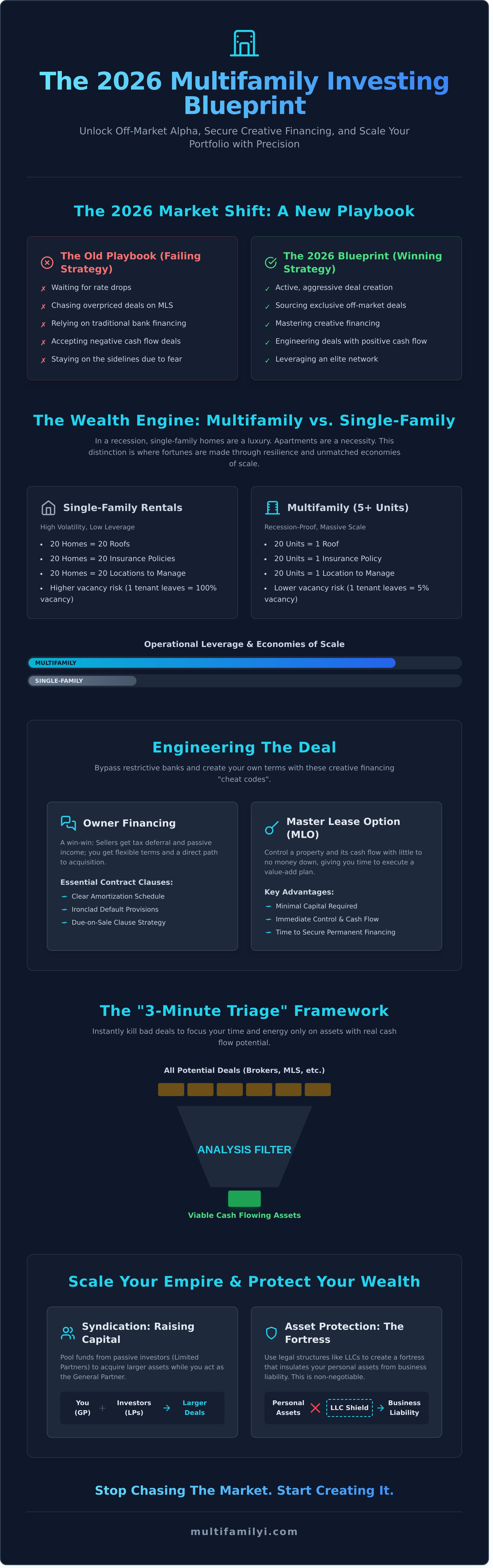
The key is understanding that apartments offer stability in a market where single-family rentals face increasing volatility. In a recessionary environment, single-family assets are luxuries; apartments are necessities. This distinction is where fortunes are made.
Why Apartments Survive Economic Shifts
The resilience of multifamily assets, particularly workforce housing, is their superpower. People always need a place to live, making your asset class fundamentally "recession-proof." The operational leverage is unmatched. Consider the difference:
Managing 20 single-family homes means 20 roofs, 20 insurance policies, and 20 locations.
Managing a 20-unit apartment building means one roof, one policy, and massive economies of scale.
To be clear, multifamily investing is the acquisition of residential buildings with 5+ units to trigger commercial valuation. If you're asking What is multifamily housing?, understand this: it’s a business, not a property.
The 2026 Market Reality: From Passive to Active Acquisition
Waiting and praying for rate drops is a failing strategy. The market has shifted permanently. The days of finding killer deals on the MLS are over. Today’s market demands an active, aggressive approach. High-performers are no longer just investors; they are deal-makers, building direct-to-seller relationships to unlock off-market opportunities before they ever become public.
This is a high-stakes game where risk must be professionally managed, not ignored. The "Multifamily Attorney" perspective is now non-negotiable, providing the strategic counsel needed to navigate complex acquisitions and shield your assets from liability. It's time to stop hunting and start creating your deal flow.
Engineering the Deal: Creative Financing and Legal Mastery
Forget what you know about traditional bank loans. The operators scaling fastest in today’s market aren't just finding deals-they are engineering them. Mastering creative financing and ironclad legal structures is the difference between buying one property and building an empire. This is where you unlock velocity and dominate the La Jolla market.
The path to massive scale in multifamily investing is paved with sophisticated deal structures that bypass the slow, restrictive conventional lending process. It's about creating your own terms and building a capital engine that works for you, not the bank.
The Power of Owner Financing
This is the ultimate 2026 "cheat code." Motivated sellers get tax deferral and passive income without management headaches. You get flexible terms, potentially lower interest rates, and a direct path to acquisition. A win-win. But your contract is your shield. Every owner-financed agreement must include:
A Clear Amortization Schedule: Outlines every payment, principal, and interest.
Ironclad Default Provisions: Defines the consequences if terms are not met.
A Due-on-Sale Clause Strategy: Specifies if and when the loan is due upon a future sale.
Beyond owner financing, a Master Lease Option (MLO) lets you control a property and its cash flow with little to no money down, giving you time to execute a value-add plan and secure permanent financing. While these creative structures allow you to move faster than those relying solely on traditional bank debt or navigating the complexities of Federal multifamily housing programs, they demand next-level financial sophistication.
Syndication and Private Equity Basics
Need to raise capital? This is how the pros do it. Syndication allows you to pool funds from passive investors (Limited Partners or LPs) while you, the General Partner (GP), find and manage the deal. You can raise capital legally using SEC Regulation D exemptions, but you must follow the rules meticulously.
Don’t have a track record? Build one. Underwrite 50 deals. Join The Network. Partner with a seasoned GP on your first deal. Your track record isn't just closed deals; it's your demonstrated expertise and your ability to execute. Every deal is built on the "Capital Stack"-the layers of debt, mezzanine financing, and equity. Understanding how to balance these elements is critical. As you scale, protecting your personal wealth is non-negotiable. Use legal structures like LLCs to insulate your personal assets from your business, creating a fortress around the wealth you're building.
Underwriting for Alpha: Analyzing Deals for Real Cash Flow
In today's high-rate environment, the old-school spreadsheet is a liability. It’s too slow, too simple, and it can’t model the economic pressures that kill deals. To win in La Jolla, you need to underwrite for alpha-the excess return above the market average. That starts with killing bad deals before they waste your time.
We call it the "3-Minute Triage." Before you dive deep, run a quick analysis on a deal’s core metrics: Does it meet your minimum cash-on-cash return? Can it clear a 1.25x debt service coverage ratio (DSCR)? If not, kill it and move on. Your time is your most valuable asset in multifamily investing.
For deals that pass the triage, you must calculate the real Net Operating Income (NOI). The broker’s pro forma is a sales document, not an operational reality. You need to stress-test their numbers, especially for utilities and insurance. We project these costs to escalate significantly. As national trends detailed in the 2026 Multifamily Investment Forecast by Marcus & Millichap suggest, operational expenses are a major factor in profitability. Smart operators are underwriting for future inflation, not yesterday's costs. Manually modeling these scenarios is a grind. Use the Multifamily Analyzer to model these scenarios instantly and get to a decision point faster.
Cap Rate vs. IRR: Which Metric Actually Matters?
Amateurs chase high cap rates, but seasoned pros know this can be a value trap. A high cap rate often signals a high-risk neighborhood or a distressed asset that will bleed you dry. Instead, focus on the Internal Rate of Return (IRR), which measures the true velocity and total return of your capital over the entire hold period. Net Operating Income (NOI) is the lifeblood of a deal; it directly dictates a commercial property's valuation by representing the asset's raw, unleveraged profitability.
Identifying "Value-Add" Opportunities
Value-add is where real wealth is created. This falls into two buckets: physical (renovations) and operational (smarter management). The easiest money is almost always in operational improvements. Implementing a Ratio Utility Billing System (RUBS) can instantly boost your NOI by passing utility costs to tenants. Spotting "lazy" management in off-market listings-evidenced by below-market rents and high vacancy-is your signal to unlock massive hidden equity.
The 5-Step Process to Sourcing Off-Market Apartment Deals
In the competitive La Jolla market, waiting for deals to appear on LoopNet is a recipe for mediocrity. Elite operators don't find deals; they create them. They engineer opportunities by going direct to the source, bypassing the competition entirely. This is how you unlock true value and accelerate your path to passive wealth.
Follow this proven 5-step framework to dominate your deal flow and secure assets the public never sees.
Identify Your Bullseye: Pinpoint specific La Jolla neighborhoods with explosive job growth and positive population migration. Data drives decisions. Go where the demand is heading, not where it’s been.
Build Your "Dream Team": Surround yourself with A-players. You need a connected broker, a sharp attorney, a world-class property manager who understands the local market dynamics, and a capital advisor like Flex V Capital LTD to help structure the financing. Your network is your net worth.
Perfect Your Logistics: Elite operators understand that time is money. This extends to travel for site visits and negotiations. Utilizing professional ground transportation, like the services found at mspcarservice.com in major business hubs, ensures you arrive focused and maintain a high-level image.
Launch a Direct-to-Owner Campaign: Execute a high-impact marketing strategy that speaks directly to a seller’s pain points. This is where you separate yourself from the institutional noise.
Submit a Standout LOI: Craft a Letter of Intent that signals you are a serious, credible buyer. While others submit "low-ball" offers, you will present a thoughtful proposal that builds trust and gets you to the negotiation table.
Conduct Ruthless Due Diligence: Never get "deal fever." Verify every assumption and trust your underwriting. This disciplined approach is a cornerstone of successful multifamily investing and protects your capital from catastrophic errors.
Building Broker Relationships That Actually Yield Deals
Brokers don't call their entire list-they call the top 5% who they know can close. To get on that list, you must present yourself as a decisive, well-capitalized buyer. The mythical "pocket listing" isn't found; it's earned through relationships built on trust and a track record of execution. Join our 5-Day Multifamily Challenge to script your first broker call and position yourself as a top operator from day one.
Direct-to-Seller Outreach Tactics
Use skip-tracing services to identify owners of distressed or under-managed properties-these are your prime value-add targets. To build instant credibility, deploy the "Attorney-Led" approach, where your legal counsel makes the initial contact. This professional introduction cuts through the clutter. Then, use a simple "Daily Newsletter" strategy to share market insights and stay top-of-mind, positioning you as the go-to buyer when they're ready to sell.
Accelerate Your Journey: The Multifamily Intelligence Ecosystem
Let's be direct: the "do-it-yourself" approach is the most expensive way to learn real estate. One bad deal in a competitive market like La Jolla can wipe out years of hard-earned capital. The ultimate shortcut to success in multifamily investing isn't more information-it's proximity. When you are surrounded by high-level operators, premier deal flow finds you, private capital becomes accessible, and catastrophic risks are identified and neutralized before they impact your bottom line.
This is the engine behind the Multifamily Intelligence Ecosystem. We've built the system to help you bypass the painful learning curve. Our Multifamily Investing Academy delivers the exact, repeatable blueprint to acquire your first 100 units. But information without execution is worthless. For true acceleration, you need a guide in the trenches with you. That’s why we created the Personal Mentorship Program-to give you direct, one-on-one access to veteran attorney and investor Charles Dobens.
Personal Mentorship vs. Online Courses
A pre-recorded video can't underwrite your specific deal structure or role-play a tough negotiation. A mentor does. Before you sign a purchase agreement that puts your capital at risk, you need an expert to stress-test your numbers. During the chaos of due diligence, our exclusive community of active investors becomes your personal advisory board, spotting red flags you might overlook. You’ll gain instant credibility by leveraging the Multifamily Intelligence brand, opening doors with brokers and sellers typically closed to new investors.
Your Next Step Toward Financial Independence
The roadmap to building your empire is simple: Analyze, Fund, Close, and Scale. We’ve laid out the strategy for building a powerful portfolio in the La Jolla market. Now, it's time to move from theory to action. Don’t just learn about creating passive wealth-start building it. Your journey to dominate the multifamily market and achieve total lifestyle freedom starts with a single, decisive step. Stop waiting for the perfect moment and start creating it with a team dedicated to your success.
The time for passive learning is over. It's time to execute. Apply for the Personal Mentorship Program today and close your next deal with confidence.
Dominate 2026: Your Final Blueprint for Multifamily Wealth
The landscape of 2026 is clear: victory in multifamily investing belongs to the prepared. It's no longer enough to find deals; you must engineer them with creative financing and underwrite them with surgical precision. Sourcing off-market opportunities isn't a luxury-it's the new standard for generating the kind of passive wealth that grants you total freedom.
This blueprint is your map, but the right ecosystem accelerates the journey. The Multifamily Investing Academy is your unfair advantage. Founded by "The Multifamily Attorney" Charles Dobens and built on over 10 years of proven mentorship success, we provide the elite network and tools you need to execute. You get the live coaching and the proprietary Multifamily Analyzer software to close deals with absolute confidence. Stop theorizing and start scaling.
Join the Multifamily Investing Academy and Start Scaling Today. Your empire awaits.
Frequently Asked Questions About La Jolla Multifamily Investing
Is multifamily investing still profitable with high interest rates?
Absolutely. High rates separate the amateurs from the operators. It forces discipline and creativity. Smart investors find value-add opportunities where they can force appreciation, outpacing interest costs. In markets like La Jolla, strong rental demand provides a buffer. This is where your deal analysis skills and The Network's insights become your unfair advantage. Dominate the market by finding deals that work in any economic climate.
How much money do I need to start investing in multifamily properties?
The barrier to entry is lower than you think. While a direct acquisition in La Jolla can require millions, you can enter the game through syndication for as little as $50,000. This strategy allows you to leverage the experience of a seasoned operator and own a piece of a high-value asset. Stop waiting on the sidelines. Your path to passive wealth can start with a single, strategic syndication investment.
What is the difference between residential and commercial multifamily?
The key distinction is financing and scale. Residential multifamily (2-4 units) typically qualifies for conventional home loans, making it more accessible. Commercial multifamily (5+ units) requires commercial loans, which are underwritten based on the property's income potential (Net Operating Income). This is where you unlock true scale. To accelerate your portfolio growth, you must transition to the commercial space and master the art of multifamily investing.
Can I buy an apartment building with no experience?
Yes, but not alone. Trying to go solo without a track record is a recipe for failure. Lenders and sellers want to see experience. The shortcut is to partner with a seasoned operator or join a syndication as a limited partner. Leverage their credibility to get your first deal done. The right network provides the team, the deal flow, and the blueprint you need to execute flawlessly from day one.
How do I find off-market multifamily deals?
Off-market deals are found through relationships, not listings. Dominate your market by building a powerful network of brokers, property managers, attorneys, and other owners. This is your deal-flow engine. Attend local meetups, join mastermind groups, and make it known what you're looking for. The best opportunities are never advertised; they are brought to you because of who you know. That’s the power of The Network.
What is a good cap rate for an apartment building in 2026?
Predicting a precise 2026 cap rate is a fool's errand; focus on the fundamentals. In a prime market like La Jolla, expect cap rates to remain compressed, likely in the 4-5% range for stabilized assets. However, a "good" cap rate depends on your strategy. For a value-add play, you might acquire at a lower cap rate, knowing you can force appreciation and increase it post-renovation. The real metric is the risk-adjusted return on your capital.
Should I invest in multifamily syndications as a passive investor?
If you want to accelerate your path to financial freedom without the operational headaches, the answer is a resounding yes. Multifamily syndications allow you to invest alongside expert operators in institutional-quality assets. You get the benefits of ownership-cash flow, appreciation, and tax advantages-while they handle the asset management. This is the ultimate strategy for busy professionals looking to build true passive wealth and scale their capital efficiently.
What legal structure is best for owning an apartment complex?
The industry standard for owning commercial real estate is a Limited Liability Company (LLC), specifically a Series LLC if available in your state. This structure provides critical liability protection, separating your personal assets from the property. For syndications, a Limited Partnership (LP) is often used with the general partner as an LLC. Always consult with a qualified real estate attorney to structure your entity for maximum protection and tax efficiency. Build your A-team.


Comments