



How to Start Investing in Multifamily Real Estate: The 2026 Wealth Accelerator Guide
Are you trapped in the endless cycle of single-family rentals-fixing toilets, chasing tenants, and watching your 'passive' income feel anything but? You know the real wealth is in scale, but the leap to apartment complexes seems impossibly complex. If the fear of commercial underwriting and raising massive capital is the only thing stopping you from learning how to start investing in multifamily real estate, then your breakthrough starts now.
This isn't another theoretical guide. This is the 2026 Wealth Accelerator, a professional blueprint designed to transition you from an overworked landlord to a dominant asset owner. We're handing you the keys to unlock high-cash-flow apartment deals and build a portfolio that works for you, not the other way around. Forget the landlord trap; it's time to become the operator you were meant to be.
Inside, you will master the art of deal syndication, build a high-level network that delivers exclusive off-market opportunities, and finally achieve the total lifestyle freedom that comes with true Passive Wealth. It’s time to scale up.
Key Takeaways
Master Forced Appreciation: Learn how to directly control an asset's value and manufacture equity by increasing its Net Operating Income (NOI)-the core of multifamily wealth creation.
Think Like a Commercial Investor: The secret to how to start investing in multifamily real estate is shifting from a "comps"-based mindset to one where value is determined by pure math and income.
Source Off-Market Deals: The most profitable assets are never publicly listed. This guide reveals the professional system for finding and rapidly analyzing deals before your competition ever sees them.
Scale with Other People's Money: You don't need millions of your own capital. Discover how to structure deals using syndication to raise private money and acquire high-cash-flow apartment complexes.
Table of Contents Why Multifamily Real Estate is the Ultimate Wealth Accelerator in 2026 The Fundamental Shift: Residential Landlording vs. Commercial Investing Sourcing and Analyzing High-Yield Multifamily Deals Funding the Deal: Navigating the Capital Stack Your Blueprint for Mastery: Joining the Multifamily Intelligence Network
Why Multifamily Real Estate is the Ultimate Wealth Accelerator in 2026
Forget the slow, grinding path of traditional investments. If you're serious about learning how to start investing in multifamily real estate, you must first understand why it is the superior vehicle for creating generational wealth. We aren't talking about duplexes or fourplexes; we're targeting commercial-grade multifamily residential housing-properties with five or more units. This is where real operators play because these assets are valued based on their Net Operating Income (NOI), not emotional comps. That means you control the value. Increase the income or decrease expenses, and you force the appreciation. You literally create equity out of thin air.
The market dynamics of 2026 are creating a unique window of opportunity. Economic pressures are forcing smaller, less efficient owners to sell, creating a wave of consolidation. This is your moment to acquire larger, more stable apartment assets and scale your portfolio faster than ever before. This is the shift from being an active, overworked landlord to a passive, strategic asset owner who achieves true lifestyle freedom through professional management.
The Scalability Factor: Houses vs. Apartments
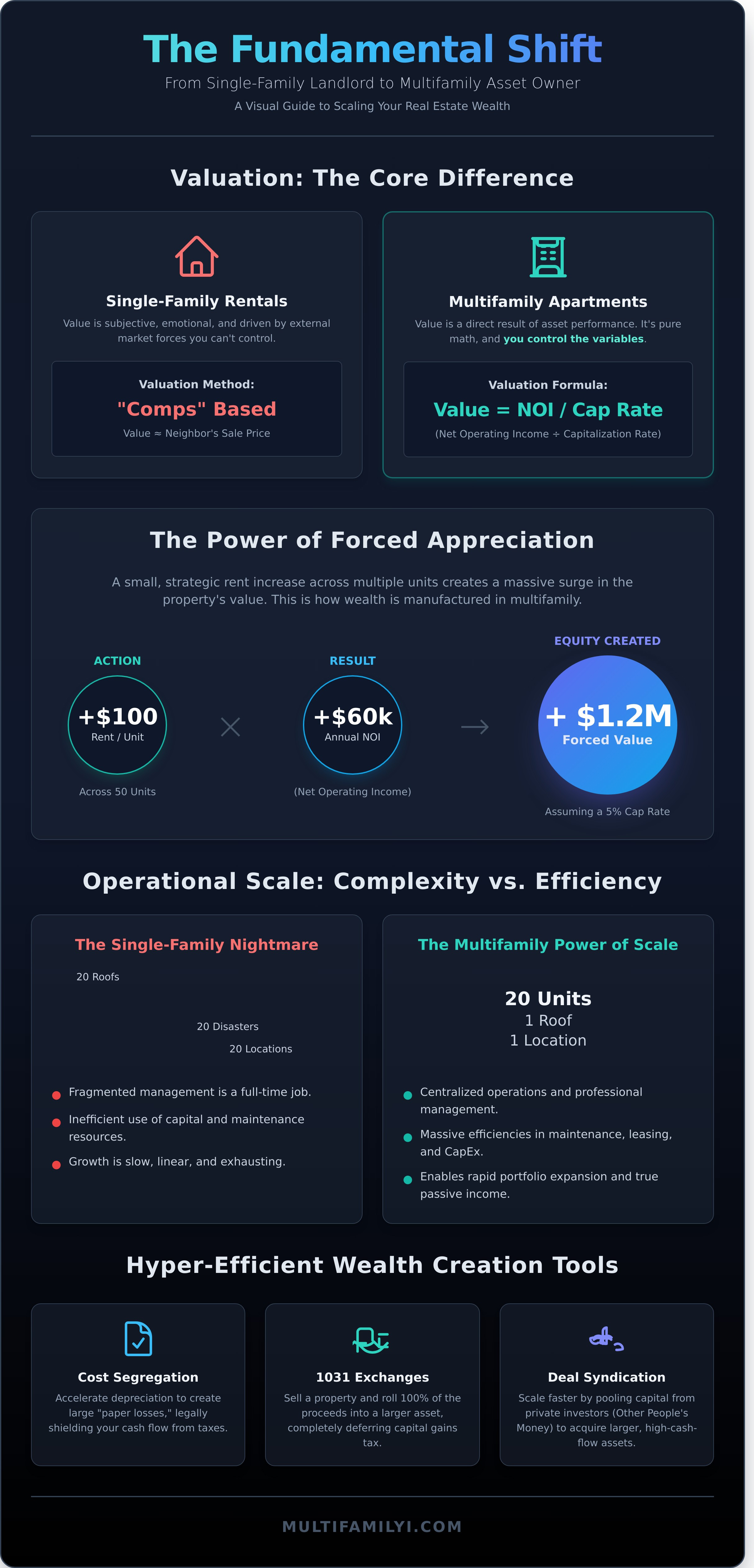
Managing 20 single-family homes is an operational nightmare. Twenty roofs, twenty tenants in different locations, twenty potential disasters. Now, imagine 20 units under a single roof. This is the power of scale. You gain massive efficiencies in maintenance, leasing, and capital projects. This concentration of resources unlocks a higher "velocity of money," allowing you to execute value-add plans and reposition assets with speed and precision that is impossible in the residential space.
For many investors looking to make this leap, the first step is often liquidating their existing single-family portfolio. Selling properties quickly for cash can provide the necessary capital for a down payment on a larger asset. Companies that specialize in this, such as Peregrine REI, offer a streamlined process for investors ready to scale up.
Tax Advantages and Passive Wealth Creation
The ultra-wealthy don't just earn more-they leverage the tax code to keep more. Multifamily investing gives you access to the most powerful tax advantages available, turning your portfolio into a hyper-efficient wealth machine.
Cost Segregation: This powerful strategy allows you to accelerate depreciation on parts of your property, creating massive "paper losses" to offset your income.
1031 Exchanges: Sell a property and roll 100% of the proceeds into a new, larger asset-completely tax-deferred. This is how you compound your way to a legacy portfolio.
Passive Income: The ultimate goal. With professional property management in place, you collect "mailbox money" that fuels your freedom and allows you to focus on professional mastery and finding the next deal.
The Fundamental Shift: Residential Landlording vs. Commercial Investing
Transitioning from single-family rentals to multifamily isn't just about more doors-it's a complete paradigm shift. Forget the landlord hustle. This is where you graduate from being a property owner to a sophisticated asset manager. To truly understand how to start investing in multifamily real estate, you must first master this mental upgrade. You're no longer in the housing business; you're in the wealth creation business.
Valuation Mechanics: It's All About the NOI
Residential properties are valued on emotion and "comps." Commercial real estate is valued on cold, hard math. The engine of this valuation is the Net Operating Income (NOI). The formula is simple but potent: Value = NOI / Capitalization (Cap) Rate. This means you control the value. Increase rent by just $100 across 50 units, and you've added $60,000 to your annual NOI. In a 5% cap rate market, you just forced over $1.2 million in new equity. That's how you dominate a market. The cap rate is simply the "temperature" of your investment location-the expected rate of return that dictates the multiple on your income.
This mathematical approach extends to financing. Lenders for your duplex cared about your W-2. Commercial lenders for a 50-unit asset care about the property's performance. The deal must stand on its own two feet. Your personal credit is secondary to the asset's ability to generate cash flow and service the debt. Understanding the financial structure of multifamily real estate, including non-recourse debt, is critical to scaling up and protecting your personal assets. This is a business, and it's financed like one.
The DIY landlord mentality will kill your growth. Multifamily is a team sport. You need a network of brokers, lenders, attorneys, and partners to execute at a high level. This is where you must decide your role. Will you be the General Partner (GP), actively finding and managing the deal? Or will you be a Limited Partner (LP), providing capital for a share of the returns and achieving true Passive Wealth?
The Professional Management Requirement
Never manage your own 10+ unit property. Your highest and best use is not fixing leaky faucets; it's finding the next deal and managing your asset manager. Treat your third-party property management company as a critical business partner. Vet them relentlessly and hold them accountable to key performance indicators (KPIs) like:
Economic Occupancy
Delinquency Rates
Budget vs. Actual Variance
Leasing Velocity
Sourcing and Analyzing High-Yield Multifamily Deals
Forget the MLS. The deals that generate true passive wealth and accelerate your path to financial freedom are never found on public websites. They are forged in the off-market trenches through strategy, relationships, and ruthless analysis. While there are countless reasons to invest in multifamily real estate, from portfolio diversification to inflation hedging, none of it matters if you can’t find and vet a profitable deal. This is where operators separate themselves from amateurs.
The secret is building a proprietary deal flow pipeline. Your goal is to see opportunities before anyone else. This means building rock-solid relationships with commercial brokers who will grant you "first look" access to their best pocket listings. Prove you can analyze fast and close with certainty, and you will become their first call. This is the ultimate competitive advantage.
The Art of the Off-Market Deal
To dominate your market in 2026 and beyond, you must go direct-to-owner. This means identifying "tired landlords" and under-managed assets ripe for a value-add takeover. Deploy data-driven direct mail and targeted digital campaigns to connect with owners directly. Position yourself as the solution to their management headaches. Furthermore, master the art of owner financing to unlock deals that traditional banks won’t touch, creating massive wins for both you and the seller.
Rapid Underwriting and Financial Modeling
You must learn to kill bad deals in under five minutes. Wasting time on non-starters is the fastest way to burn out. Mastering this rapid analysis is a non-negotiable step in learning how to start investing in multifamily real estate. Your initial "5-minute drill" should verify these core metrics:
The Numbers Check: Does the seller's proforma make sense? Immediately stress-test their income claims and expense ratios against market realities.
Cash-on-Cash Return: Project your first-year return on capital. If it doesn't meet your minimum threshold after factoring in debt, it's a dead deal.
Budget for Reality: Always underwrite with realistic vacancy loss (5-8%) and capital expenditure (Capex) reserves ($250-$400/unit/year). Ignoring these will destroy your returns.
Once a deal passes this initial filter, you can dive deep into the T-12 (trailing 12-month profit and loss) and the Rent Roll. Look for inconsistencies, deferred maintenance clues, and opportunities to immediately increase Net Operating Income (NOI).
Funding the Deal: Navigating the Capital Stack
Finding a killer multifamily deal is half the battle. Funding it is what separates the spectators from the players who build massive wealth. To dominate this space, you must master the art of raising capital. This isn’t just about getting a bank loan; it’s about structuring deals to maximize returns and accelerate your growth.
Every deal is funded by a "capital stack." Think of it as layers of money with different risk levels and returns. Understanding this is fundamental to how to start investing in multifamily real estate at a professional level.
Senior Debt: This is the primary loan from a bank or agency lender (like Fannie Mae or Freddie Mac). It's the cheapest capital and typically covers 60-80% of the purchase price. For stabilized assets, agency debt is king. For value-add plays requiring rehab funds, a short-term bridge loan gives you the flexibility to execute your business plan.
Mezzanine Financing: A hybrid of debt and equity that fills the gap between your senior loan and the equity you raise. It’s more expensive but can be a powerful tool to reduce your equity requirement.
Equity: This is the cash you and your investors contribute. It’s the most expensive capital because equity partners take the most risk and demand the highest returns. This is where you create life-changing wealth.
Real Estate Syndication 101
Syndication is how you scale beyond your own bank account. You pool capital from private investors to acquire larger assets. Most deals are structured under SEC Regulation D as a 506(b) offering (for investors you have a pre-existing relationship with) or a 506(c) (allowing you to advertise to accredited investors). Your "Deal Deck" is your pitch, outlining the property, business plan, and projected returns. Profits are often split with a preferred return (e.g., investors get the first 8% of profits) followed by a "promoted" interest split (e.g., 70/30) that rewards you for performance.
Creative Financing and Owner Carry
Ready to unlock off-market deals? Get creative. Negotiate a seller carry-back note where the owner acts as the bank for a portion of the down payment. This instantly reduces your cash-to-close requirement. For ultimate leverage, explore a "Master Lease Option" to control a property and its cash flow without immediate ownership. These advanced strategies, combined with private equity partnerships, are exactly how savvy investors scale to 100+ units and achieve true lifestyle freedom. Mastering how to start investing in multifamily real estate means mastering the money. And that requires a team-your first hire should always be a multifamily attorney to ensure your deals are SEC-compliant from day one.
Your Blueprint for Mastery: Joining the Multifamily Intelligence Network
You've learned the fundamentals, but the single most expensive mistake you can make in commercial real estate is going it alone. The gap between theory and a closed deal is a minefield of costly errors. The fastest path to building a dominant portfolio is to plug directly into a network that has already mastered the game.
This is more than just a course; it's about gaining proximity to power. When you're serious about learning how to start investing in multifamily real estate, the right network isn't a luxury-it's your most valuable asset. It’s your source for elite deal flow, private capital, and the high-level strategy required to scale up and achieve passive wealth.
The Value of a Personalized Mentorship
A high-level mentor doesn't just teach; they accelerate your entire trajectory. Imagine getting direct, real-time feedback on your deal structures and underwriting, sidestepping the "rookie" mistakes that kill profits before they start. You will:
Leverage the reputation of a seasoned professional to unlock financing opportunities that are closed to outsiders.
Gain an insider's look at deal sourcing and asset management from a proven operator.
Shortcut the path to your first 50 units and build unstoppable momentum in your market.
Within the Multifamily Investing Academy, you’ll connect with a vetted community of active deal partners, private equity investors, and operators-the exact people you need to syndicate and close your first deal.
Next Steps: Accelerate Your Journey
Information without action is worthless. Stop analyzing and start executing. Here are your immediate action items to get in the game:
Download the Multifamily Analyzer to start practicing your underwriting on live deals today.
Subscribe to the daily newsletter for exclusive 2026 market trends and insights.
The path to mastering how to start investing in multifamily real estate is paved with decisive action. Your next move is clear. Stop dreaming about financial freedom and start building it.
Join the 5-Day Multifamily Challenge and dominate your market. This is where your new life begins.
Your Final Step: From Blueprint to Multifamily Empire
You've absorbed the blueprint. You now understand that multifamily isn’t just an asset class-it’s the ultimate wealth accelerator for 2026. The path to success is clear: make the fundamental shift from residential landlording to commercial investing, master the art of sourcing high-yield deals, and strategically navigate the capital stack to fund your acquisitions.
But knowledge alone doesn't close deals. The most critical component of how to start investing in multifamily real estate is taking decisive, guided action. This is where information ends and transformation begins. Don't go it alone. The Multifamily Personal Mentorship Program is your direct line to the winner's circle. Led by the renowned Multifamily Attorney, Charles Dobens, our program provides the exact framework, proprietary Multifamily Analyzer software, and elite network that has helped our students acquire thousands of units. This is your chance to stop learning and start earning.
The time for passive wealth and total freedom is now. Apply for the Multifamily Personal Mentorship Program and let's start building your legacy. Your empire awaits.
Frequently Asked Questions
How much money do I really need to start investing in multifamily real estate?
Forget the myth that you need millions. When learning how to start investing in multifamily real estate, you can enter the market by house hacking a 2-4 unit property with as little as 3.5% down using an FHA loan. For larger deals, you syndicate, pooling capital from other investors. Your real asset isn't your bank account-it's your ability to find a killer deal and leverage The Network to fund it. Start with knowledge, not a massive down payment.
Can I buy an apartment building with no experience?
Absolutely. Lack of experience is a roadblock, not a dead end. Your path to success is to partner with a seasoned operator or join a mentorship group that accelerates your growth. Leverage their credibility and track record to get the lender and investors on board. This allows you to learn the business from the inside while building your own portfolio. In this game, your network is your experience. Use it to win.
What is a good Cap Rate for a multifamily property in 2026?
Stop chasing a universal "good" cap rate. The right cap rate is market-specific and deal-specific. A prime A-class market might trade at a 4-5% cap, while a C-class value-add deal could demand 6-8% or higher to justify the risk. The real question is: what is the pro forma cap rate after you execute your business plan? Focus on the forced appreciation you can create, not just the entry number. That's how you unlock true passive wealth.
Do I need a special license to syndicate real estate deals?
No, you do not need a real estate or securities license to be a General Partner and syndicate a deal. However, you absolutely need a qualified securities attorney on your team. This is non-negotiable. They will structure your offering correctly to ensure you are fully compliant with SEC regulations. Trying to save money here is the fastest way to derail your career. Invest in your team to protect your assets and your investors.
How do I find off-market multifamily deals in a competitive market?
You dominate competitive markets by creating your own deal flow. Forget the MLS. Build deep relationships with commercial brokers, property managers, attorneys, and even city officials. Launch targeted direct-to-seller campaigns. The best deals are never publicly listed; they are found through relentless networking and strategic outreach. You hunt for opportunities, you don't wait for them to appear. This is how you scale up and build a real business.
What is the difference between a 506(b) and a 506(c) offering?
This is a critical distinction for raising capital. A 506(b) offering is for raising funds from investors with whom you have a substantive, pre-existing relationship-no public advertising is allowed. A 506(c) lets you advertise your deal to the world, but every single investor must be accredited, and you must take reasonable steps to verify their status. Choose your path based on the strength of your network versus your need for public reach.
Is it better to invest in multifamily or single-family homes right now?
Single-family is a starting point; multifamily is the destination for serious wealth creation. While single-family homes are a great learning tool, multifamily offers superior economies of scale, professional management, and commercial financing advantages. For those still navigating the residential market, you can discover Noble Real Estate for expert guidance. One vacancy in a rental house can wipe out your cash flow. One vacancy in a 50-unit building is a minor line item. If you're serious about achieving financial freedom, the choice is clear. Multifamily is the blueprint for scaling.
How does owner financing work in commercial real estate?
Owner financing, or a seller carryback, is a powerful tool for closing deals when traditional banks won't cooperate. Essentially, the seller becomes your bank for a portion of the purchase price, holding a note on the property. This can reduce your cash-to-close requirement, bridge a gap in financing, and prove the seller’s confidence in the asset. It’s a creative strategy that separates amateur investors from elite operators who know how to structure win-win deals.


Comments