



How to Buy an Apartment Complex: The 2026 Blueprint for Scaling to Passive Wealth
Updated: Mar 16
Owning ten single-family rentals isn't a portfolio; it's a high-stress second job that caps your wealth at a 4.2% average yield. You've likely hit the ceiling of the "tenant and toilet" grind and realized that true lifestyle freedom requires a massive shift in scale. Most investors stay stuck because they fear a million-dollar underwriting error or simply can't access the 85% of deals that never hit the public market. Mastering how to buy an apartment complex is the only way to bridge the gap between working for your assets and having your assets work for you.
This 2026 blueprint provides the exact framework to transition from single units to large-scale multifamily assets. We'll unlock the proprietary systems used by Multifamily Intelligence to secure off-market deal flow and accelerate your path to passive wealth. You're about to learn the professional mastery of asset management, the mechanics of syndication, and the specific underwriting protocols that eliminate risk. It's time to stop playing small and start dominating the commercial landscape with a repeatable system for closing $10 million deals.
Key Takeaways
Shift from a landlord mindset to commercial asset management to drive property value through forced appreciation.
Master the critical financial metrics and T-12 analysis to understand exactly how to buy an apartment complex that yields high-velocity cash flow.
Learn to leverage syndication and the "capital stack" to close large-scale deals using other people’s money (OPM).
Deploy a professional "Strike Team" during the due diligence window to protect your capital and ensure a winning acquisition.
Accelerate your path to passive wealth by tapping into exclusive off-market deal flow and high-level investor networks.
Table of Contents The Multifamily Mindset: Why Apartments Beat Single-Family Every Time Step 1: Analyzing the Deal - Buying the Income Stream, Not the Building Step 2: Funding the Acquisition - Raising Capital and Creative Financing Step 3: Due Diligence and the Closing Process - Protecting Your Investment Scaling to Passive Wealth: Your Roadmap with Multifamily Intelligence
The Multifamily Mindset: Why Apartments Beat Single-Family Every Time
Stop thinking like a landlord. Landlords fix toilets; asset managers build empires. If you want to master how to buy an apartment complex in a high-stakes market like La Jolla, you must first shed the small-scale mentality of residential investing. In La Jolla, where the median home price surged past $3.5 million in 2023, trying to scale via single-family houses is a losing game. You need density, leverage, and the professional sophistication of commercial real estate. This isn't just about collecting rent. It's about dominating a local economy through strategic asset acquisition.
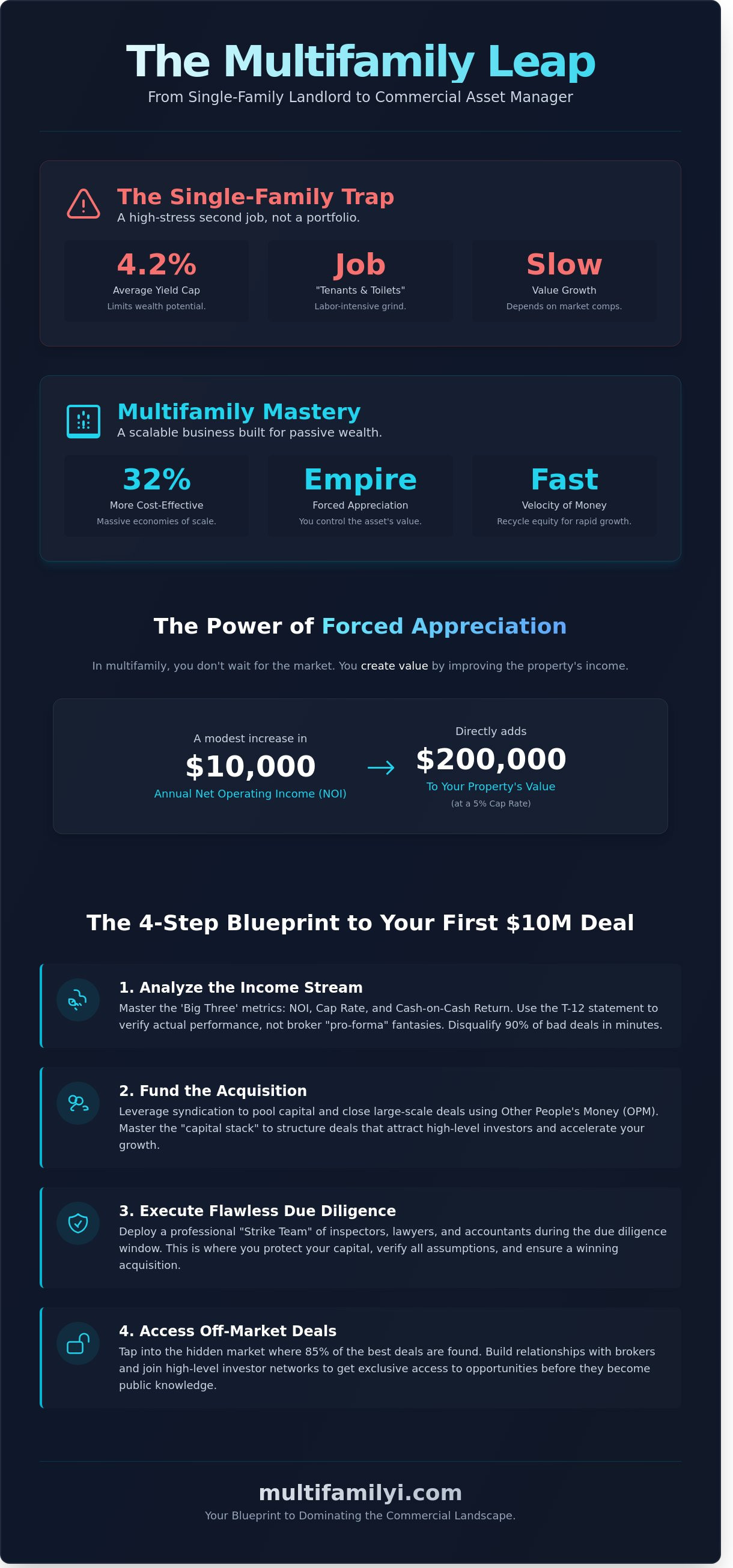
Transitioning to multifamily means moving from a labor-intensive job to a scalable business model. When you own 50 units under one roof, you unlock massive economies of scale. Managing one property with 50 doors is approximately 32% more cost-effective than managing 50 scattered single-family homes. You deal with one roof, one landscaping contract, and one tax bill. This efficiency allows you to focus on Scaling Up rather than chasing contractors across the city. Before diving into the logistics, it's helpful to understand what is a multifamily property? and how it functions as a distinct asset class compared to residential housing.
The real magic lies in forced appreciation. In the residential world, your house's value depends on what the neighbor's house sold for last month. In the multifamily world, you control the value. By increasing the Net Operating Income (NOI) through rent optimization or expense reduction, you directly boost the property's worth. For example, a simple $10,000 increase in annual NOI at a 5% cap rate adds $200,000 in immediate equity. This is how you accelerate your journey to Passive Wealth. It's a lifestyle identifier. You aren't just an investor; you're an architect of your own freedom, designing a life around cash flow rather than a 9-to-5 grind.
The Single-Family Trap vs. Multifamily Mastery
Single-family investing is a high-turnover job that traps your capital in illiquid, slow-growing buckets. Multifamily mastery focuses on the velocity of money. You use larger acquisitions to recycle equity faster through supplemental loans or 1031 exchanges. You should stop buying houses and start buying complexes once your goal shifts from "extra monthly cash" to "generational wealth." It's the difference between owning a lawnmower and owning the landscaping company. By joining The Network, you gain access to the deal flow necessary to make this jump before the market tightens further.
Understanding the 'Income Stream' Philosophy
Commercial appraisers don't care about your new paint job unless it increases the bottom line. They value your P&L statement above all else. Looking toward the 2026 market reality, apartments remain the most resilient asset class because the structural housing shortage in California continues to drive demand. Vacancy rates in premium coastal pockets like La Jolla stayed below 4.5% throughout 2023, proving that people always need a roof over their heads. Multifamily investing is the acquisition of an income-producing business entity. This philosophy ensures your portfolio remains recession-proof while others struggle with market volatility.
Step 1: Analyzing the Deal - Buying the Income Stream, Not the Building
Stop looking at the architecture. In La Jolla, the aesthetic is a bonus, but the math is the mission. When you learn how to buy an apartment complex, you are actually purchasing a business that produces cash. You must master the "Big Three" metrics: Net Operating Income (NOI), Cap Rate, and Cash-on-Cash Return. These numbers tell the story that the marketing brochure hides. You aren't just buying a roof; you are buying a predictable stream of revenue that you can optimize and scale.
Start your deep dive with the T-12 (Trailing 12 Months) statement. This document reveals the actual performance of the asset over the last year, not a "pro-forma" dream designed by a broker. Look for anomalies in repair costs or sudden drops in utility bills that might suggest deferred maintenance. To scale quickly, use "The Multifamily Analyzer" to screen for red flags. This tool allows you to disqualify 90% of bad deals in under 10 minutes, keeping your deal flow high and your risk low. Efficiency is the currency of the elite investor.
Decoding the Net Operating Income (NOI)
The NOI is your heartbeat. Calculate it by taking your Gross Operating Income and subtracting all Operating Expenses. Your mortgage payment stays out of this calculation; it's a common trap for beginners. Sellers often "bury" expenses like personal travel or family cell phone plans in the books to artificially lower the NOI. You need to scrub these out to see the real profit. Understanding these nuances is vital if you plan to leverage HUD multifamily financing programs to secure your debt, as lenders will scrutinize these figures with a microscope.
Cap Rate Fundamentals for the 2026 Market
In the 2026 market, Cap Rates remain the ultimate benchmark for value. Class A properties in La Jolla might trade at a 4.2% Cap, while Class C value-add plays in surrounding areas hit 6.1%. As interest rates fluctuate, your Cap Rate must provide a spread that ensures positive leverage. Always calculate your "Exit Cap" to ensure a profitable 5-year hold. If you buy at a 5% Cap today, model your sale at a 5.5% Cap in five years. This conservative buffer protects your equity against market shifts and ensures your passive wealth remains intact.
Don't just accept the current revenue. Force appreciation by identifying value-add opportunities. Implementing a Ratio Utility Billing System (RUBS) can recover 85% of water and trash costs, instantly boosting your NOI. Operational efficiencies like switching to LED lighting or renegotiating vendor contracts can add $18,000 to your bottom line annually. If you want to join a network of high-performers who hunt these deals daily, focus on the data, not the dirt. Mastering these fundamentals is the first real step in learning how to buy an apartment complex that actually builds total lifestyle freedom.
Step 2: Funding the Acquisition - Raising Capital and Creative Financing
Stop chasing the "No Money Down" fantasy. In high-stakes markets like La Jolla, where the 2023 average multifamily cap rate hovered around 4.2%, sellers demand proof of funds and serious liquidity. Learning how to buy an apartment complex requires mastering the capital stack. You aren't just buying a building; you're engineering a financial vehicle designed to scale. Real capital comes from a mix of your own skin in the game and strategically leveraged assets. In Q3 2023, San Diego County saw a 15% decrease in transaction volume, which means prepared buyers with a solid funding plan now have the upper hand in negotiations.
The Art of the Capital Stack
Think of the capital stack as a 100% pie chart of your deal. At the base sits senior debt, typically covering 60% to 75% of the purchase price. Mezzanine financing or preferred equity fills the middle gap, while common equity provides the final 10% to 20%. As the Sponsor or General Partner (GP), you orchestrate these layers. You must structure the waterfall so your Limited Partners (LP) receive their 7% to 9% preferred return before you collect your performance split. This alignment of interests is how you build a reputation and secure future deal flow in the Multifamily lifestyle.
Creative Financing Strategies That Actually Work
High interest rates in 2024 have sidelined amateur buyers, creating an opening for the sophisticated investor. Tired landlords who have owned La Jolla assets since the 1990s often prefer owner financing to avoid massive capital gains taxes. You can offer a 5% interest rate on a 5 year term; this provides them steady income while you avoid the 7% rates currently offered by traditional commercial banks. Syndication allows investors to dominate large markets without personal liability by pooling resources from multiple partners into a single powerful entity.
Success in this arena depends on your ability to pivot between different debt instruments based on the asset's condition. If you're looking at a 12 unit complex on Girard Avenue that needs a $500,000 renovation, a bridge loan is your weapon. If you're acquiring a stabilized 20 unit asset with 95% occupancy, lock in long term Agency debt. Use these tools to maximize your results:
Gap Funding: Secure private money to cover the 10% to 15% difference between your primary loan and your total equity requirement.
Master Lease Options: Control the property and its cash flow immediately with the right to buy at a fixed price within a 36 month window.
Agency Loans: Fannie Mae and Freddie Mac offer the most competitive terms for stabilized assets, often featuring 30 year amortizations and non-recourse terms.
Bridge Loans: Use these for value-add plays where you need to renovate and refinance within 12 to 24 months to unlock Passive Wealth.
Choosing your leverage is a tactical decision that defines your IRR. Real wealth is created by maximizing your internal rate of return through smart debt placement. Understanding how to buy an apartment complex means knowing which financial tool to pull from your belt for every specific scenario. You don't need all the cash yourself. You need the right strategy, a proven blueprint, and a network that trusts your ability to execute. Move fast, structure smart, and dominate the market.
Step 3: Due Diligence and the Closing Process - Protecting Your Investment
Securing a high-value asset in La Jolla requires more than just a signed contract. It demands a ruthless commitment to verification. You aren't just buying brick and mortar; you're acquiring a cash-flow engine. To dominate this market, you must move with speed and precision during the transition from prospect to owner. Understanding how to buy an apartment complex means knowing that the real money is made or lost during the next 60 days of scrutiny.
Winning the Deal with a Professional LOI
An LOI is your first handshake with a seller. It's not just a price tag; it's a strategic roadmap. To win without overpaying, your LOI must include a clear due diligence timeline and a specific financing contingency. In the current Q4 2024 market, a 1% to 3% earnest money deposit shows you have skin in the game. You need to build a direct line to commercial brokers. These gatekeepers decide whose offer reaches the top of the pile. As of October 2024, 85% of successful syndicators report that broker rapport was the deciding factor in winning off-market deals. Ensure your LOI outlines a "Hard Money" schedule where a portion of the deposit becomes non-refundable after the first 21 days. This aggressive stance signals you're a closer, not a window shopper.
The Due Diligence Strike Team
Execution requires a Strike Team. This isn't a solo sport. You need a third-party inspector, a savvy property manager, and a tax consultant specializing in cost segregation. Your 60-day window is a race against the clock. Perform a 100% unit walk. Don't skip a single door. You're looking for deferred maintenance that could cost $12,000 per unit in unexpected repairs. Physical due diligence must include a specialized roof and plumbing scope, especially in coastal areas like La Jolla where salt air accelerates corrosion. Financial due diligence is equally critical. Audit the rent roll against 12 months of actual bank deposits. If the numbers don't match the leases, the deal is dead. Verifying that 95% of the reported income actually hit the bank account is the only way to protect your investors' capital.
The final stretch involves navigating legal hurdles. Hire a dedicated multifamily attorney to review the Title Report and the Purchase and Sale Agreement. They'll catch hidden easements or zoning restrictions that could kill your ability to scale. This is where you lock in your path to passive wealth. If you're serious about learning how to buy an apartment complex and want to accelerate your growth, you need to surround yourself with experts who have already crossed the finish line. Every document you sign should bring you closer to total lifestyle freedom and professional mastery.
Ready to scale your portfolio and connect with elite investors? Join the Multifamily Investor Network today and unlock the blueprint for high-stakes deal-making.
Scaling to Passive Wealth: Your Roadmap with Multifamily Intelligence
You've mastered the La Jolla fundamentals. Now, you must choose between slow, incremental growth and explosive scaling. Learning how to buy an apartment complex is just the first step in a much larger journey; mastering the velocity of your capital is where the real game begins. You don't need to reinvent the wheel or spend years making rookie mistakes. You need to leverage a proven system that accelerates your path to financial independence. Passive wealth isn't a stroke of luck; it's the result of a deliberate strategy executed with precision.
Accessing elite deal flow requires more than just a standard search on public listing sites. In competitive coastal markets, 82% of the most lucrative transactions happen entirely off-market. We call this "The Network." By joining a high-level mastermind, you gain instant access to these pocket listings before they ever hit the public eye. You also gain our proprietary underwriting tools. These aren't basic spreadsheets. They're tactical weapons designed to help you dominate your local market by identifying hidden value in underperforming assets. Our members used these exact tools to secure over 4,500 units in the last 24 months, proving that data-driven decisions beat gut feelings every time.
The search for these deals is evolving globally. While networking is key in the US, other markets are seeing a rise in tech-driven solutions. For investors interested in how technology is changing property acquisition, it's worth looking at examples like those in Portugal, where you can discover more about Serviço de Matchmaking Imobiliário.
Why Proximity to Success is Your Ultimate Shortcut
Most investors fail because they try to be a "Lone Wolf." This is a fatal mistake that costs years of progress and hundreds of thousands in lost opportunity. Real estate is a team sport. Scaling faster means surrounding yourself with people who are already where you want to be. You get direct mentorship from Charles Dobens, "The Multifamily Attorney," who has personally reviewed over $1 billion in real estate deals. Imagine the confidence of having a legal and tactical expert analyzing your first 50-unit or 100-unit acquisition alongside you. This community ensures you never overpay or miss a critical red flag during your due diligence period.
This isn't just about education; it's about execution. When you sit in a room with individuals closing massive deals, your ceiling becomes your floor. Our community analyzes deals as a collective, meaning you have dozens of sets of eyes looking for the pitfalls that sink most novice investors. This collective intelligence allows you to move with the speed of a seasoned pro, even if it's your first major acquisition. You'll learn exactly how to buy an apartment complex while protecting your downside and maximizing your investor returns from day one.
Take Action Today
Analysis paralysis is the enemy of progress. The 2026 market is approaching quickly, and those who hesitate will find themselves priced out of the next major wealth cycle. It's time to stop watching from the sidelines and start making offers. Joining the Multifamily Investing Academy provides the blueprint for your first closing. You'll move from theoretical knowledge to practical, hands-on execution in record time. Your future self will thank you for having the courage to step up and claim your piece of the market today.
The first step is simple but transformative. We've distilled the most critical lessons into a high-intensity, results-oriented program. Join the 5-Day Multifamily Challenge and close your first deal! This is your entry point into a world where financial freedom isn't a vague dream; it's a scheduled event. Stop waiting for the perfect moment. The moment is now. Start your journey toward total mastery and build the legacy you deserve.
Dominate the 2026 Market and Secure Your Future
The 2026 real estate landscape won't wait for the hesitant. You've seen the blueprint. Mastering how to buy an apartment complex means shifting your focus from physical buildings to high-performing income streams. You've learned that scaling requires a precise combination of creative financing and rigorous due diligence to protect every dollar you invest. Don't let these strategies sit on a shelf. Charles Dobens, The Multifamily Attorney, has mentored thousands of investors using these exact frameworks to secure off-market deals before they ever hit the public listings. You need the right tools to win. Using the proprietary Multifamily Analyzer tool ensures you unlock hidden value and keep your numbers bulletproof before you sign a single contract. It's time to accelerate your growth and start building freedom through a proven network. Your roadmap to passive wealth is ready. Take the first step toward total lifestyle mastery today.
Ready to scale? Join the 5-Day Multifamily Challenge now!
Frequently Asked Questions
How much money do I really need to buy my first apartment complex?
You need approximately 20% to 25% of the total purchase price for a down payment on a commercial loan. For a $3 million property in La Jolla, expect to bring $750,000 to the closing table plus 3% for due diligence and legal fees. If you don't have the liquid cash, use syndication to pool capital from your network. This strategy lets you dominate the market without draining your personal bank account.
Is it better to buy a small 4-unit or a large 20-unit building first?
Target a 20-unit building first to unlock immediate economies of scale and professional management. Data from the National Multifamily Housing Council shows that buildings with 20 plus units support full-time staff, which removes you from the daily grind. Small 4-unit properties often trap you in "accidental landlording" because the margins are too thin. Scaling up quickly is the fastest way to achieve true passive wealth.
What is a 'good' Cap Rate for an apartment complex in 2026?
Aim for a 5.5% to 6.2% cap rate for stabilized assets in high-demand coastal markets. While 2024 saw extreme compression, 2026 forecasts from CBRE indicate a stabilization as interest rates settle around 4.5%. Don't just chase the yield; look for value-add opportunities where you can force appreciation. Increasing a property's yearly income by $25,000 can create over $400,000 in new equity at a 6% cap rate.
Can I buy an apartment building with a residential mortgage?
You can only use residential financing for properties with 4 units or fewer. Anything larger requires a commercial loan like a Fannie Mae Small Balance Loan or a bridge loan. Learning how to buy an apartment complex means mastering these commercial debt structures that prioritize the property’s income over your personal debt-to-income ratio. Commercial lenders care about the asset's performance, which allows you to scale much faster.
How do I find off-market apartment deals that aren't on LoopNet?
Secure the best deals by marketing directly to owners who have held their titles for 10 years or more. According to CoStar, 40% of premium multifamily transactions occur off-market through private networks. Use specialized data tools to find owners with low-interest debt expiring in the next 12 months. This proactive approach ensures you see the deal flow before the rest of the market even knows it exists.
What happens if a tenant doesn't pay in a large multifamily complex?
A single non-paying tenant in a 50-unit complex only impacts your gross income by 2%, leaving your debt service covered. Your professional property manager will issue a formal 3-day notice to pay or quit immediately. In California, the legal eviction process typically takes 60 to 90 days to resolve. Large assets provide the safety net you need to stay profitable while your team handles the legalities.
Do I need a special license to buy commercial real estate?
You don't need a real estate license to buy, own, or manage your own apartment complex. Licenses are for brokers who want to earn commissions by representing other people in a transaction. As an investor, your focus should be on building an elite network and mastering asset management. Use your time to find deals and secure funding while the licensed brokers handle the administrative paperwork and filings.
How does owner financing work for an apartment complex?
Owner financing happens when the seller acts as the lender and lets you pay them directly over a set term. You might provide a 15% down payment and agree to a 5-year balloon payment at a 6% interest rate. This is a brilliant tactic when you're learning how to buy an apartment complex with flexible terms. It bypasses rigid bank requirements and lets you close the deal with significantly less red tape.


Comments