


The Ultimate Rental Calculator Guide: Mastering Multifamily Analysis in 2026
That moment of hesitation. It’s the difference between closing a game-changing multifamily deal and watching another investor scale past you. You see the asset, but the numbers feel like a foreign language-a paralyzing mix of confusing commercial math and the gut-wrenching fear of overpaying. Forget guesswork. The right rental calculator isn't just a tool; it's your weapon for underwriting with institutional-grade precision. It’s the key to unlocking the confidence you need to stop analyzing and start acquiring.
This is your definitive guide to mastering multifamily analysis for 2026. We’re handing you the playbook to transform complex financials into a crystal-clear “Go/No-Go” decision. You will learn to generate professional-grade reports that command respect from lenders and partners, giving you the unshakeable confidence to scale from your first deal to a 50+ unit empire. It’s time to stop guessing and start building your legacy of Passive Wealth.
Key Takeaways
Master the math-driven analysis that separates elite commercial operators from amateur landlords.
A high-performance multifamily rental calculator moves beyond simple cash flow to master income-based valuation, unlocking a property's true potential.
Discover how advanced strategies like the Ratio Utility Billing System (RUBS) can dramatically boost your Net Operating Income and transform a deal's profitability.
Learn to convert your raw analysis into a compelling investor deck that secures capital and helps you close bigger deals, faster.
Table of Contents Beyond the Basics: Why Every Multifamily Deal Needs a Precision Rental Calculator The 5 Critical Metrics Your Rental Calculator Must Master to Scale Multifamily vs. Single-Family Calculations: The Commercial Advantage From Calculation to Closing: Using Data to Raise Capital and Dominate The Multifamily Intelligence Edge: Why Our Analyzer Beats a Basic Spreadsheet
Beyond the Basics: Why Every Multifamily Deal Needs a Precision Rental Calculator
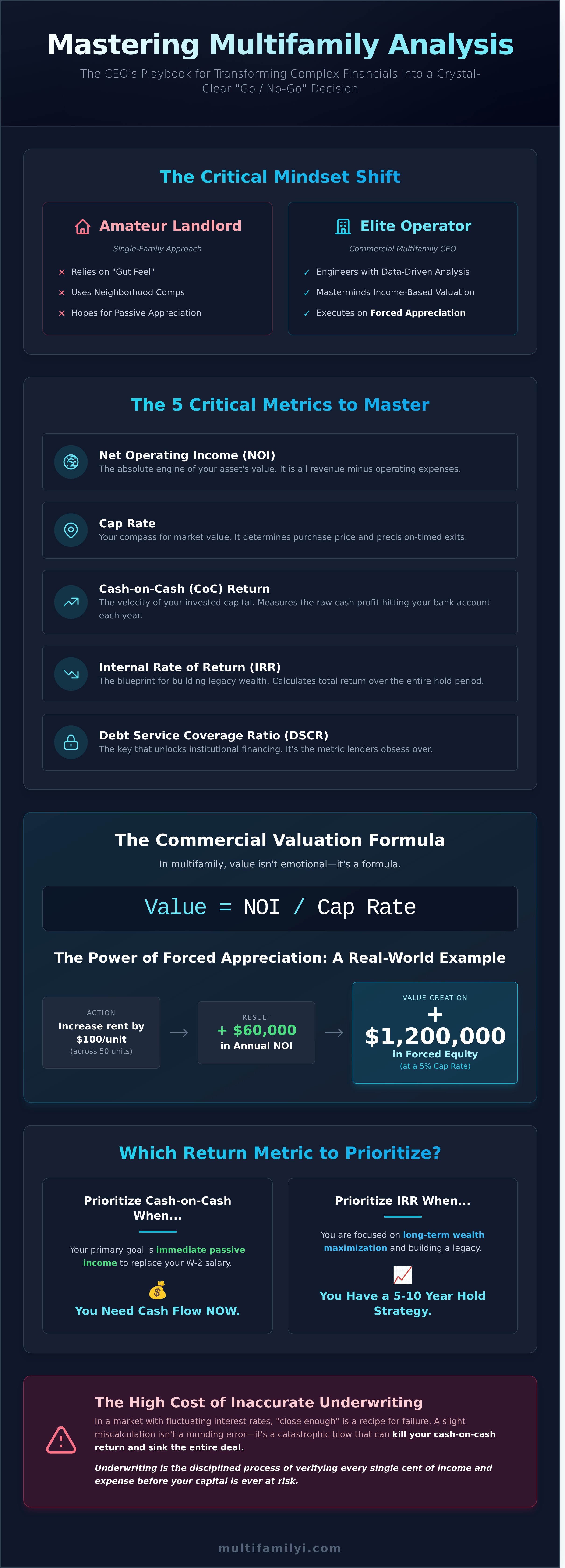
Stop thinking like a landlord. Start operating like a CEO. The leap from single-family rentals to multifamily assets is a shift from a hobby to a high-stakes business. Your "gut feel" and neighborhood comps that worked for a duplex are liabilities when you’re analyzing a 20-unit apartment building in La Jolla. Here, success isn't guessed-it's engineered. A professional multifamily rental calculator isn't just a spreadsheet; it's a strategic engine for commercial asset valuation.
Forget passive appreciation. The name of the game in commercial real estate is Forced Appreciation. This is the deliberate process of increasing a property’s Net Operating Income (NOI) to directly increase its value. Your ability to execute this strategy begins and ends with the precision of your initial analysis.
The Shift from Residential to Commercial Mindset
In the world of 5+ unit properties, value is a function of income, not what the building next door sold for. Commercial lenders don’t care about granite countertops; they care about your numbers. The output from your calculator becomes your business plan-a clear, data-driven argument for why they should fund your deal. When you present this standardized data to partners and investors in The Network, you’re speaking the language of serious capital. Clean numbers unlock massive opportunities.
The High Cost of Inaccurate Underwriting in 2026
In a market defined by fluctuating interest rates, "close enough" is a recipe for failure. A slight miscalculation directly impacts your Debt Service Coverage Ratio (DSCR), the metric that determines if you can even get a loan. Missing a single 5% expense line item on a multi-million dollar asset isn't a rounding error; it’s a catastrophic blow that can instantly kill your cash-on-cash return and sink the entire deal. Every financial metric is scrutinized, and a robust property investment calculator is built to stress-test these critical assumptions. Remember this definition: Underwriting is the disciplined process of verifying every single cent of income and expense before your capital is ever at risk.
The 5 Critical Metrics Your Rental Calculator Must Master to Scale
Forget basic spreadsheets. To dominate the La Jolla market and truly scale your portfolio, your tools must move beyond simple rent vs. mortgage math. A professional-grade rental calculator is your command center for deal analysis, and it must master these five core metrics to unlock exponential growth and passive wealth.
Net Operating Income (NOI): The absolute engine of your asset's value.
Cap Rate: Your compass for market value and precision-timed exits.
Cash-on-Cash (CoC) Return: The velocity of your invested capital.
Internal Rate of Return (IRR): The blueprint for building legacy wealth.
Debt Service Coverage Ratio (DSCR): The key that unlocks institutional financing.
NOI and Cap Rate: The Commercial Valuation Formula
In multifamily, value isn't emotional-it's a formula: Value = NOI / Capitalization Rate. This is the heartbeat of commercial real estate. Your Net Operating Income (all revenue minus operating expenses) directly dictates your property's worth. A small change in NOI creates a massive change in value. For example, increasing rent by just $100 across 50 units adds $60,000 in annual NOI. In a 5% cap rate market, you just forced $1.2 million in new equity. That's how you scale. Understanding if the market cap rate is compressing (driving values up) or expanding (driving them down) is mission-critical for timing your exit for maximum profit.
Measuring Performance: Cash-on-Cash vs. IRR
Not all returns are created equal. Cash-on-Cash is your "lifestyle" metric-the raw cash profit from your invested capital hitting your bank account each year. It's the fuel for achieving financial freedom. IRR, on the other hand, is the gold standard for total wealth projection. It calculates your total return over the entire hold period, factoring in cash flow, principal paydown, and appreciation at sale. Mastering the nuances of analyzing multifamily properties means knowing which metric to prioritize for your specific goals.
Prioritize Cash-on-Cash When: Your primary goal is immediate passive income to replace your W-2. You need cash flow now.
Prioritize IRR When: You are focused on long-term wealth maximization and have a 5-10 year hold strategy. This is the institutional-level metric for building a legacy.
Finally, there's the metric your lender obsesses over: the Debt Service Coverage Ratio (DSCR). This ratio (NOI / Total Debt Service) proves your property can pay its own mortgage. Lenders require a DSCR of 1.25x or higher. If you don't meet this threshold, you don't get the loan. It’s the ultimate gatekeeper to financing your deal, making it a non-negotiable output for any serious rental calculator.
Multifamily vs. Single-Family Calculations: The Commercial Advantage
Stop thinking like a homeowner and start operating like a CEO. The fundamental difference between single-family and multifamily investing isn't the size of the loan-it's the valuation model. A single-family home’s value is dictated by neighborhood "comps," a largely emotional and uncontrollable metric. A multifamily asset, however, is valued like a business: based on its Net Operating Income (NOI). This puts you in control. Every dollar you add to the bottom line directly increases the property's forced appreciation. A sophisticated rental calculator for La Jolla must be built on this commercial foundation.
Many investors mistakenly believe multifamily is "riskier" because the numbers are bigger. This is the #1 misconception holding them back. True risk lies in having all your income tied to one tenant in one house. With multifamily, your risk is diversified across multiple doors, creating a stable, predictable cash flow machine.
The Power of Economies of Scale
Analyzing and managing a 10-unit building is exponentially more efficient than juggling 10 scattered single-family homes. Think about it: one roof, one insurance policy, one property manager. This consolidation drives down your per-unit operating costs. Your management fee for a 20-unit building might be 7%, while managing 20 separate houses could easily cost 10% per door, crushing your margins. Furthermore, your vacancy calculation changes dramatically. When a single-family home is empty, you're 100% vacant. In a 10-unit building, one empty unit is a manageable 10% vacancy. Your calculator must reflect real La Jolla market data, a core principle of sophisticated institutional investment strategies that separates amateurs from professional operators.
Unlocking Value Through RUBS and Ancillary Income
Here is where you truly accelerate your wealth. Implementing a Ratio Utility Billing System (RUBS) is a game-changer. By billing tenants for their proportional share of utilities like water and trash, you move a massive expense off your books and directly onto your NOI. This single operational tweak can add hundreds of thousands of dollars to your property’s valuation at sale. A powerful rental calculator allows you to model this impact instantly. Beyond RUBS, multifamily assets offer multiple income streams that single-family investors can only dream of:
Reserved Parking: Charge a premium for covered or assigned spots.
Laundry Facilities: App-based or coin-operated laundry is a pure profit center.
Pet Fees: Both one-time fees and monthly "pet rent" boost revenue.
Storage Units: Rent out on-site cages or closets for extra income.
Late Fees & Application Fees: Enforce your lease to capture administrative income.
In addition to increasing ancillary income, actively managing major operating expenses like utilities is crucial for maximizing NOI. For instance, sophisticated operators use smart platforms to monitor and reduce energy consumption across their portfolio; you can discover Intelli-EMS to learn more about how these systems work at an enterprise level.
Don't just guess at these numbers. Use the Multifamily Analyzer to rapidly model the impact of these variables and see how they supercharge your returns.
From Calculation to Closing: Using Data to Raise Capital and Dominate
A powerful rental calculator is your launchpad, not the destination. The numbers it generates are the raw fuel for your real mission: raising private capital and closing deals that build generational wealth. To win in a competitive market like La Jolla, you must translate those calculations into a compelling narrative that sophisticated investors understand and trust. This is how you move from amateur analyst to capital-raising authority.
Your analysis becomes the core of a professional "Investor Deck." This isn't just a spreadsheet; it's a story backed by undeniable data. You must confidently explain the "Capital Stack"-the structure of debt and equity. Think of it this way: debt is the bank’s cheap, secured money, while equity is your partners' risk capital fighting for higher returns. Speaking this language fluently positions you as a peer, not a rookie.
The secret weapon? Sensitivity Analysis. Show investors you’ve stress-tested the deal. Prove that even with a dip in occupancy or a rise in expenses, the asset still performs. This foresight is what separates a good deal from a fundable one.
As your operations grow, this level of financial rigor often requires professional oversight. Many scaling investors turn to fractional CFO services from firms like SA Unlimited to ensure their financial strategy and reporting meet institutional standards.
The Art of the Deal Presentation
High-net-worth individuals don’t invest in properties; they invest in operators. They need to see that you’ve anticipated every risk. Use the stress-testing features in your rental calculator to model worst-case scenarios. When a skeptical partner asks, "What if vacancy hits 15%?" you’ll have a data-driven answer ready. This builds unbreakable trust. Once your numbers are solid, a Letter of Intent (LOI) serves as the first market validation of your assumptions, solidifying your position to investors.
Building Your Passive Wealth Engine
Why does "The Network" value a standardized analyzer over a custom spreadsheet? Because it creates a universal language of performance. It’s verifiable, professional, and fast. When you present a deal to a commercial broker using a trusted format, you command respect. Your offers are taken seriously because your underwriting is instantly credible. This data-backed confidence allows you to negotiate better terms and secure better deals. Mastering these high-stakes conversations is the final step, and our Personal Mentorship Program is the proven path to get you there.
The Multifamily Intelligence Edge: Why Our Analyzer Beats a Basic Spreadsheet
Your spreadsheet is holding you back. While a basic rental calculator can handle simple math, it fails to capture the intricate financial dynamics of high-value La Jolla properties. To dominate this market, you need a tool built for professional operators-one that moves at the speed of opportunity. That tool is our proprietary Multifamily Analyzer.
We didn't just build a better calculator; we engineered an underwriting machine. This isn't just about numbers; it's about intelligence. Our system is infused with the legal and financial logic of Charles Dobens, the Multifamily Attorney, ensuring your analysis is not just fast, but fundamentally sound. Paired with real-time market data from our Daily Newsletter, you're not just guessing-you're executing with precision.
Ready to see it in action? Stop wrestling with outdated formulas and start making offers. Put our analyzer to the test in our 5-Day Challenge and learn how to underwrite deals like a pro.
Proprietary Tools for Professional Investors
Generic tools deliver generic results. Our Multifamily Analyzer is your unfair advantage, designed to accelerate your path to passive wealth. It’s more than a simple rental calculator; it's a complete deal analysis system that gives you the "Speed to Lead."
Automate Complexity: Instantly model sophisticated tax implications and depreciation schedules that basic spreadsheets can't handle.
Analyze in Minutes, Not Hours: Underwrite a potential acquisition in under 10 minutes, allowing you to evaluate more deals and submit winning offers first.
Unlock True Insight: Move beyond surface-level metrics. Our "Multifamily Intelligence" framework is your North Star for building a scalable, recession-resistant portfolio.
Join a Community of Master Connectors
The most powerful tool is useless without a network to validate your assumptions. Your analysis is only the beginning. Inside the Multifamily Investing Academy, you connect with a community of elite operators who pressure-test your numbers, share market intel, and open doors to exclusive off-market deals you won't find anywhere else. Don't just analyze deals-get them funded and closed with the power of The Network.
Stop investing alone. It's time to surround yourself with the best in the business.
Join the Multifamily Investing Academy and Scale Your Portfolio
From Calculation to Closing: Your Blueprint for Market Domination
The path to multifamily mastery is paved with precision, not guesswork. We've established that a generic spreadsheet is your biggest liability, while mastering critical commercial metrics is your non-negotiable key to scaling your portfolio and raising capital. The difference between a basic rental calculator and a professional-grade analyzer is the difference between staying on the sidelines and commanding the deal flow. Your analysis is your ultimate leverage-it’s what convinces partners and closes deals.
It’s time to stop guessing and start winning. Equip yourself with the intelligence edge used by elite operators. Backed by over a decade of specialized coaching from The Multifamily Attorney Charles Dobens, our analyzer delivers an unfair advantage, including exclusive access to off-market deal sourcing strategies. This is your moment to accelerate past the competition and build lasting, passive wealth.
Dominate the Market: Get the Multifamily Analyzer Software Today and unlock the future of your portfolio. Your empire awaits.
Frequently Asked Questions About The La Jolla Rental Calculator
What is the most important metric in a multifamily rental calculator?
Net Operating Income (NOI) is the single most critical metric. NOI is your gross income minus all operating expenses, before debt service. This number is the pure measure of an asset's profitability and directly drives its valuation. Dominate your underwriting by focusing on an accurate NOI calculation; it’s the foundation for your Cap Rate, cash flow, and every other key performance indicator you will analyze.
How is a commercial rental calculator different from a residential one?
A commercial calculator values a property based on its income-generating potential, using metrics like NOI and Cap Rate. It treats the asset like a business. A residential calculator, for a single-family home, often relies heavily on comparable sales ("comps"). For multifamily, you must think like a commercial investor. The value isn't what a similar building sold for-it's what the income stream is worth.
Can I use a rental calculator for an apartment building I don’t own yet?
Absolutely. That is its primary purpose. A powerful rental calculator is your essential tool for underwriting potential acquisitions *before* you make an offer. It allows you to stress-test assumptions, model different scenarios, and identify value-add opportunities. This is how you analyze dozens of deals quickly and confidently, ensuring you only pursue properties that meet your strict criteria for building passive wealth.
What is a "good" Cap Rate for a multifamily deal in 2026?
There is no universal "good" Cap Rate; it is entirely market-dependent. For a premium market like La Jolla, you can expect compressed Cap Rates, potentially in the 4-5.5% range. The key is the spread between your Cap Rate and your interest rate. A successful deal is one where you can force appreciation by increasing the NOI, thereby creating a more valuable asset regardless of the entry Cap Rate.
How do I account for property management fees in my analysis?
You must include property management as a non-negotiable line item in your operating expenses. A professional third-party fee typically runs 4-8% of Effective Gross Income. Even if you plan to self-manage, pay yourself. Underwriting with a professional management fee ensures your deal works for the next buyer and accurately reflects the true cost of running the asset, protecting your NOI.
Why do lenders require a Debt Service Coverage Ratio (DSCR) of 1.25 or higher?
Lenders demand a DSCR of 1.25 or higher as a margin of safety. This ratio proves the property's Net Operating Income is 25% greater than its annual mortgage payments. This cash flow buffer ensures the loan can be paid even if vacancy rises or unexpected expenses occur. Meeting this threshold demonstrates your asset is a low-risk, stable investment and is the key to unlocking institutional-grade financing.
Should I include capital expenditures (CapEx) in my monthly rental calculation?
Yes, always. While CapEx is not an operating expense, you must factor in a monthly reserve for it. These are major, infrequent costs like new roofs, HVAC systems, or parking lot resurfacing. A conservative estimate is $250-$350 per unit, per year. Failing to budget for CapEx is a critical error that erodes cash flow. Sophisticated investors plan for these costs to ensure long-term profitability.
How do I calculate the "Exit Value" of a multifamily property?
The Exit Value, or terminal value, is calculated by taking your projected NOI at the time of sale (e.g., in Year 5) and dividing it by the projected Exit Cap Rate. The Exit Cap Rate is an assumption based on future market conditions. Your ability to execute a business plan that increases NOI directly inflates your Exit Value, which is how you generate massive returns for yourself and your investors.


Comments